Announcements
Introduction
GSAOI is designed to be used with GeMS at Gemini South. GSAOI is located at the f/32 output focus of Canopus and can deliver near diffraction limited images in the wavelength interval of 0.9 - 2.5 μm over a 85" x 85" field-of-view, with a scale of 0.02" per pixel. There are four gaps between the arrays of ~2.4mm, corresponding to ~2.5" on sky. It is equipped with a set of broad- and narrow-band filters, a pupil imager to set the instrument alignment and a defocus lenses to null non-common path wavefront error between Canopus and GSAOI. The GSAOI detector is composed of four Rockwell HAWAII-2RG arrays that form a 4080 x 4080 pixel focal plane. The properties of GSAOI near-infrared camera are summarized in the following sections.

Guiding Options
- Introduction
- Canopus WFS limiting magnitudes
- PWFS1 limiting magnitudes
- Available guiding configurations and guide star selection
- Examples
Introduction
GeMS requires Natural Guide Stars (NGSs) to compensate for tip-tilt and plate-scale modes variation. The NGSs can be sensed using the CANOPUS Wave Front Sensors (CWFS). Ideally, three of these guide stars should be available to compensate for the plate-scale dynamical errors, however GeMS may work with 2 or even 1 CWFS with reduced performance. The observation with one or two CWFSs implies a slow degradation of the full-width half maximum (FWHM) over the GSAOI field of view, proportional to the distance to the CWFS (see Schirmer et al. 2015 for details about the GeMS performance with one NGS). The degradation in the performance is smaller than the typical anisoplanatic effect observed with a single AO system.
In July 2019, the Natural Guide Star Wave Front Sensor (NGS WFS) unit on Canopus was replaced by a new guiding unit called Natural Guide Star Next Generation Sensor (NGSNGS or NGS2). NGS2 is based on a single Electron-Multiplied CCD (EMCCD) focal plane array and uses configurable guiding windows (multi-region of interest) to read at rates up to 800 Hz.The on-sky characterization of the new guiding unit have been taken in place in October 2019. The NGS2 on-sky commissioning results show an improvement in sensitivity of about ~2.5 magnitudes, compared to the previous NGS guiding unit. The commissioning results show also a vastly improvement in acquisition and offsetting. The NGS2 Canopus WFS (CWFS) limiting magnitudes were verified during the on-sky commissioning in December 2019. The new limiting magnitudes for the Canopus WFS are listed in the Canopus WFS limiting magnitudes section below. More information about the NGS2 can be found in the CANOPUS Wave Front Sensors (CWFS) web page.
The focus sensing to compensate for sodium layer altitude variations with the former NGS system was obtained using CWFS3. With NGS2 this is not possible. The slow focus information is obtained using an off-axis Peripheral WFS 1 (PWFS1) star. Since the PWFS1 is not used for guiding and only to compensate the sodium layer variations, stars with fainter magnitudes can be used. The off-axis PWFS1 limiting magnitudes are given in the PWFS1 limiting magnitudes section.
Canopus WFS limiting magnitudes
The limiting magnitudes (bright and faint) of the Canopus WFSs (CWFSs) for different image quality constraints are presented in the table below. The bright limits are based on previous measurements and have not been characterized yet.
| CWFS Limiting magnitudes (R Vega mag) | ||||
| IQ | CC | SB | Bright | Faint |
| 20%-ile | 50%-ile | Any | 10.0 | 18.3 |
| 70%-ile | 50%-ile | Any | 9.5 | 18.0 |
| 85%-ile | 50%-ile | Any | 9.0 | 17.7 |
Important Note: The difference in brightness between the three CWFSs should not be larger than 3 mag.
PWFS1 limiting magnitudes
The limiting magnitudes of the PWFS1 for different image quality constraints are presented in the table below. Only the faint limits are listed.
| PWFS1 Limiting Magnitudes (R Vega mag) | |||
| IQ | CC | SB | Faint Limits |
| 20%-ile | 50%-ile | Any | 16.70 |
| 70%-ile | 50%-ile | Any | 16.45 |
| 85%-ile | 50%-ile | Any | 16.20 |
Available guiding configurations and guide star selection
The NGSs can be sensed using only the CANOPUS Wave Front Sensors (CWFS).
The following configurations can be accepted:
- 3 CWFS stars
- 2 CWFS stars
- 1 CWFS star
To compensate for tip-tilt and plate-scale modes, the NGSs should be positioned as close as possible to an equilateral triangle about the science target. Best constellations (or best asterism) are the ones that cover most of the field, or the more distant the stars are, the lower the plate-scale error will be. Care must be exercised in selecting these stars so that they remain accessible during dithered observations.
When the asterism is not the optimal or the number of NGS is less than 3 NGS (2 or 1 NGS), the users might expect variations in the delivered FHWM and in the Strehl ratio across the GSAOI FoV when compared to an optimal asterism selection (see Schirmer et al. 2015 for details). Note that the performance of the system not only depend on the selected NGS constellation, the number of NGSs and their brightnesses, but also depend on the laser guide star (LGS) photons return (this parameter varies seasonally), turbulence profiling (Cn2(h)), non-common path aberrations and other AO optimization and calibration parameters. The system performance can be evaluated and visualized using the Observing Tool. Instructions of how to visualize and evaluate the performance of a selected asterism are described in the GSAOI OT Details web page.
Examples
Example of fields using NGS2 and different guide star configurations are shown below. NOTE: the use of a galaxy or a star cluster as a CWFS is NOT an option.
Example 1: 3 CWFSs
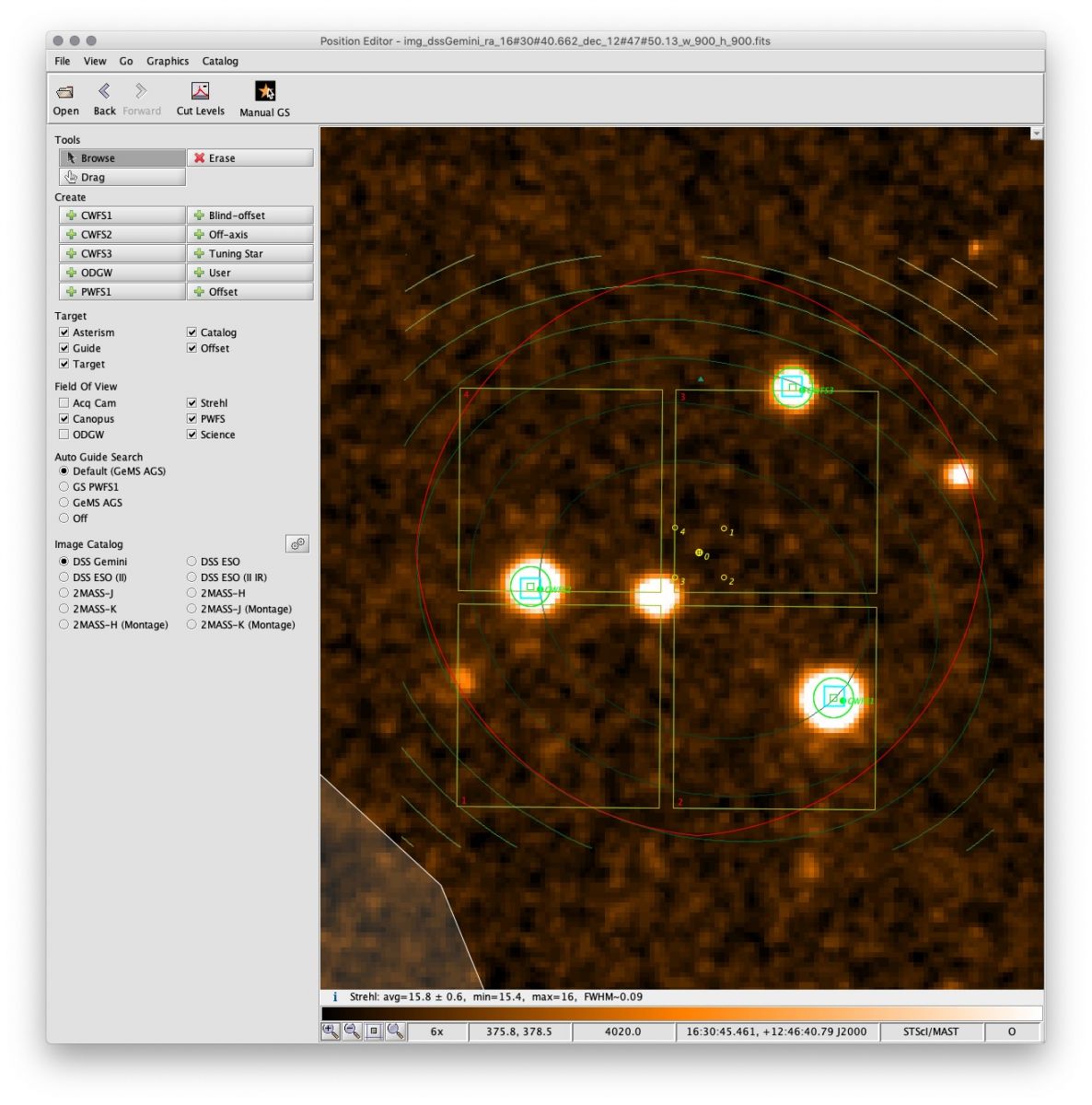
An example of an optimal natural guide stars configuration is given below. The three CWFS stars are positioned as close as possible to an equilateral triangle. The magnitudes of the CWFS range from 12.96 to 15.71 in R band. The average Strehl ratio in Ks-band, the associated error, the minimum and maximum values, calculated using the MASCOT algorithm, and the average FWHM expected for IQ=70%/CC=50%/SB=Any conditions are shown in position editor at the bottom. The Strehl map is visualized in the position editor as narrow curved green/yellow lines (see GSAOI OT Details page for details). Note that the Strehl map displayed in the position editor does not take into account the Laser Guide Stars, however the map provides a good representation of the expected performance. The Strehl ratio and associated errors, the min, max Strehl values and the FWHM provided at the bottom of the OT Position Editor are scaled to match the value given in the GeMS performance web page. In this example, we can expect a good performance, i.e. an uniform PSF and good correction across the entire GSAOI field of view.
Example 2: 2 CWFSs
An example of 2 NGS stars configuration. The magnitudes of the two available CWFSs are 10.6 and 11.6 in R band. The expected average Strehl ratio and FWHM in Ks-band for IQ=70%/CC=50%/SB=Any are 11.3% and 0.09 arcsec, respectively. Note that because the Strehl map does not take account the location and contribution of the Laser Guide Stars, the lines shown in the position editor do not reflect the true Strehl variation across the GSAOI field of view. However, the values displayed at the bottom of the Position Editor are correct. The correction will be better close to the two CWFS stars and degraded toward the edge of the GSAOI field view. Therefore you may expect a lower performance across the GSAOI field of view compared to an asterism with 3 CWFS: a fairly uniform PSF but with increasing FWHM values, proportional to the distance to the CWFSs.

Example 3: 1 CWFS:
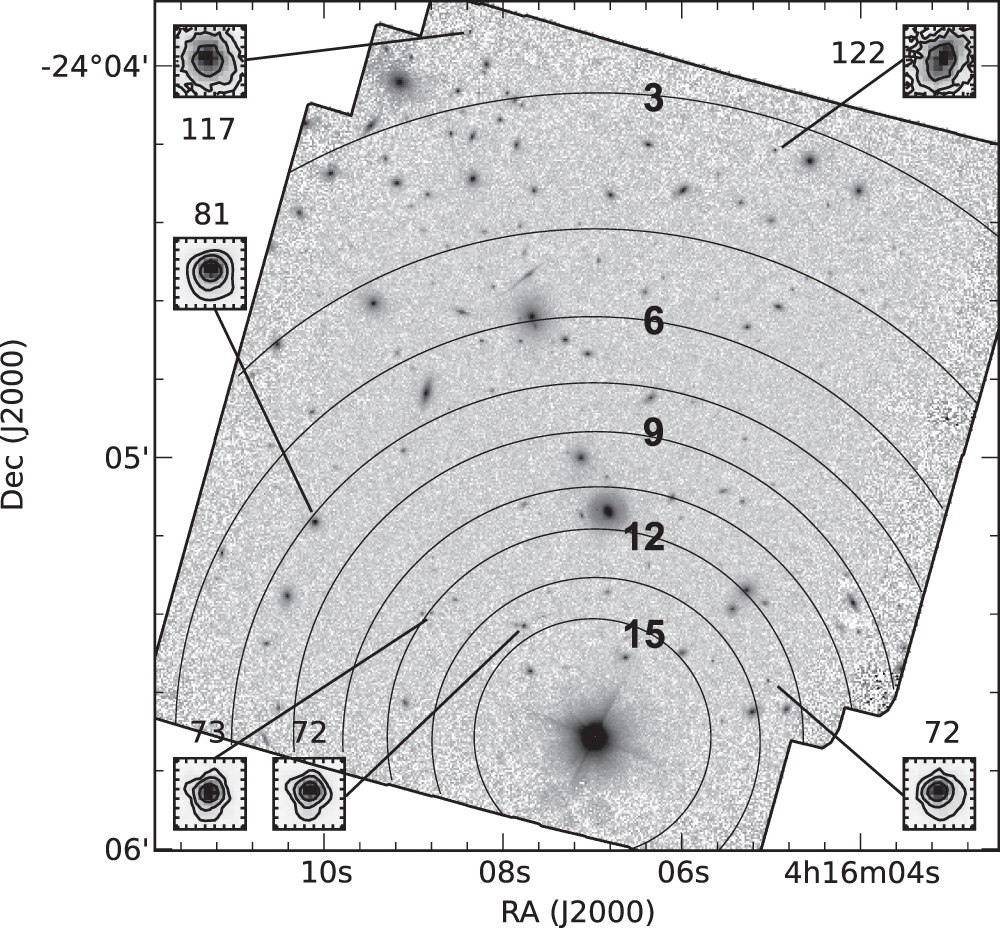
An example of one NGS star configuration. Left: DSS image of the Gemini Frontier Field galaxy cluster MACSJ 0416.1-2403 displayed in the OT position editor. The magnitude of the CWFS is 13.4 mag in R-band. The expected average Strehl and FWHM in Ks-band for IQ=70%/CC=50%/SB=Any are 6.9% and 0.090 arcsec, respectively. The correction will be better close to the WFS star and degraded toward the edge of the GSAOI field view. Therefore you can expect a fairly uniform PSF, but with variable and poorer FWHM across the GSAOI field of view toward the edges. Note that only point-like sources can be used as NGS. Right: Ks-band image of the galaxy cluster MACSJ 0416.1-2403 observed with GeMS/GSAOI (see Fig.8 in Schirmer et al. 2015). As expected, the PSF is fairly uniform, but the FWHM and Strehl ratio show variations toward the edges of the image. The FWHM increases from 72 to 122 mas while the Strehl decreases from 15% to 3% from the location of the NGS. The average Strehl ratio and FWHM shown in the image are consistent with the values provided by the MASCOT algorithm in the OT.

Sensitivity
This section presents the expected imaging sensitivities for GSAOI. The first table lists the limiting magnitude, the saturation magnitude, the assumed Strehl ratio and the sky brightness for each filter. The second table lists the background contribution from different sources for all filters. The imaging sensitivities presented here are theoretical and have been obtained using a model for the object (point-source) and background signals. These estimated values are a good approximation of what it is expected for GSAOI. Accurate sensitivity values will be derived during the GSAOI and GeMS commissioning. For the modeling, the following parameters were assumed:
- Detector dark current of 0.05 e-/s/pix, a read noise of 5 e-, using multiple reads and detector quantum efficiency of ~ 80%
- Background signal considerations: airglow emission and thermal emission from the sky, telescope, cryostat window, cryostat interior and GeMS.
| GSAOI Image Sensitivities: 1 hour on-source integration, 0.4" natural seeing through 0.08" x 0.08" square aperture and photometric conditions (50%-il Cloud Cover) | ||||
| Filter | Limiting Magnitude (mag) | Saturation Magnitude (mag)(1) | Assumed Strehl Ratio | Sky Brightness (mag/arcsec2) |
| Z | 25.6 | 14.8 | 0.2 | 17.1 |
| J | 24.1 | 13.9 | 0.2 | 14.9 |
| H | 24.1 | 14.0 | 0.4 | 14.0 |
| K(prime) | 23.9 | 13.3 | 0.6 | 13.5 |
| K(short) | 23.8 | 13.2 | 0.6 | 13.4 |
| K | 23.7 | 13.2 | 0.6 | 13.3 |
| J-continuum | 23.1 | 11.7 | 0.2 | 15.0 |
| H-continuum | 22.9 | 11.5 | 0.4 | 14.1 |
| CH4(short) | 23.6 | 13.1 | 0.4 | 13.9 |
| CH4(long) | 23.4 | 12.7 | 0.4 | 13.8 |
| K(short) continuum | 22.7 | 10.9 | 0.6 | 13.6 |
| K(long) continuum | 22.5 | 10.6 | 0.6 | 13.5 |
| He I 1.083 μm | 23.7 | 12.0 | 0.2 | 16.1 |
| H I Pγ | 23.5 | 11.5 | 0.2 | 16.2 |
| H I Pβ | 22.5 | 11.5 | 0.2 | 14.0 |
| [Fe II] 1.644 μm | 22.7 | 11.4 | 0.4 | 13.8 |
| H2O | 23.3 | 11.8 | 0.6 | 13.9 |
| He I (2p2s) | 22.5 | 10.8 | 0.6 | 13.3 |
| H2 1-0 S(1) | 22.6 | 10.8 | 0.6 | 13.4 |
| H I Brγ | 22.6 | 10.7 | 0.6 | 13.5 |
| H2 2-1 S(1) | 22.5 | 10.6 | 0.6 | 13.5 |
| CO Δv=2 | 22.4 | 11.2 | 0.6 | 12.6 |
(1) Saturation magnitudes are estimated assuming a minimum integration time of 5 sec and detector full well depth of 50,000e-
| GSAOI Image Background Contribution (600 sec integration)(*) | ||||||
| Filter |
Airglow (e-/pix) |
Sky Thermal (e-/pix) | Telelescope Thermal (e-/pix) | GeMS Thermal (e-/pix) | Window Thermal (e-/pix) | Total (e-/pix) |
| Z | 3867 | 0 | 0 | 0 | 0 | 3897 |
| J | 17904 | 0 | 0 | 0 | 0 | 17934 |
| H | 39048 | 1 | 5 | 16 | 1 | 39101 |
| K(prime) | 22167 | 378 | 2162 | 6652 | 428 | 31819 |
| K(short) | 21285 | 447 | 2555 | 7860 | 507 | 32685 |
| K | 19069 | 1002 | 4249 | 13072 | 849 | 38273 |
| J-continuum | 1807 | 0 | 0 | 0 | 0 | 1838 |
| H-continuum | 3216 | 0 | 0 | 0 | 0 | 3246 |
| CH4(short) | 15301 | 0 | 0 | 1 | 0 | 15332 |
| CH4(long) | 14851 | 0 | 2 | 7 | 0 | 14891 |
| K(short) continuum | 2468 | 13 | 106 | 327 | 21 | 12966 |
| K(long) continuum | 430 | 107 | 579 | 1782 | 116 | 3045 |
| He I 1.083 μm | 796 | 0 | 0 | 0 | 0 | 826 |
| H I Pγ | 462 | 0 | 0 | 0 | 0 | 492 |
| H I Pβ | 4611 | 0 | 0 | 0 | 0 | 4641 |
| [Fe II] 1.644 μm | 4045 | 0 | 0 | 1 | 0 | 4076 |
| H2O | 4730 | 87 | 106 | 327 | 20 | 5302 |
| He I (2p2s) | 3183 | 45 | 74 | 230 | 15 | 3577 |
| H2 1-0 S(1) | 3024 | 7 | 146 | 449 | 29 | 3685 |
| H I Brγ | 2285 | 15 | 221 | 680 | 44 | 3275 |
| H2 2-1 S(1) | 946 | 63 | 484 | 1491 | 97 | 3112 |
| CO Δv=2 | 251 | 1228 | 2718 | 8360 | 549 | 13134 |
(*) Model background signals for each filter assume a dark current of 30 e-/s/pix in 600 sec integration.
Note: the model background signals for each filter presented in the table have to be verified and confirmed during the GeMS + GSAOI commissioning.
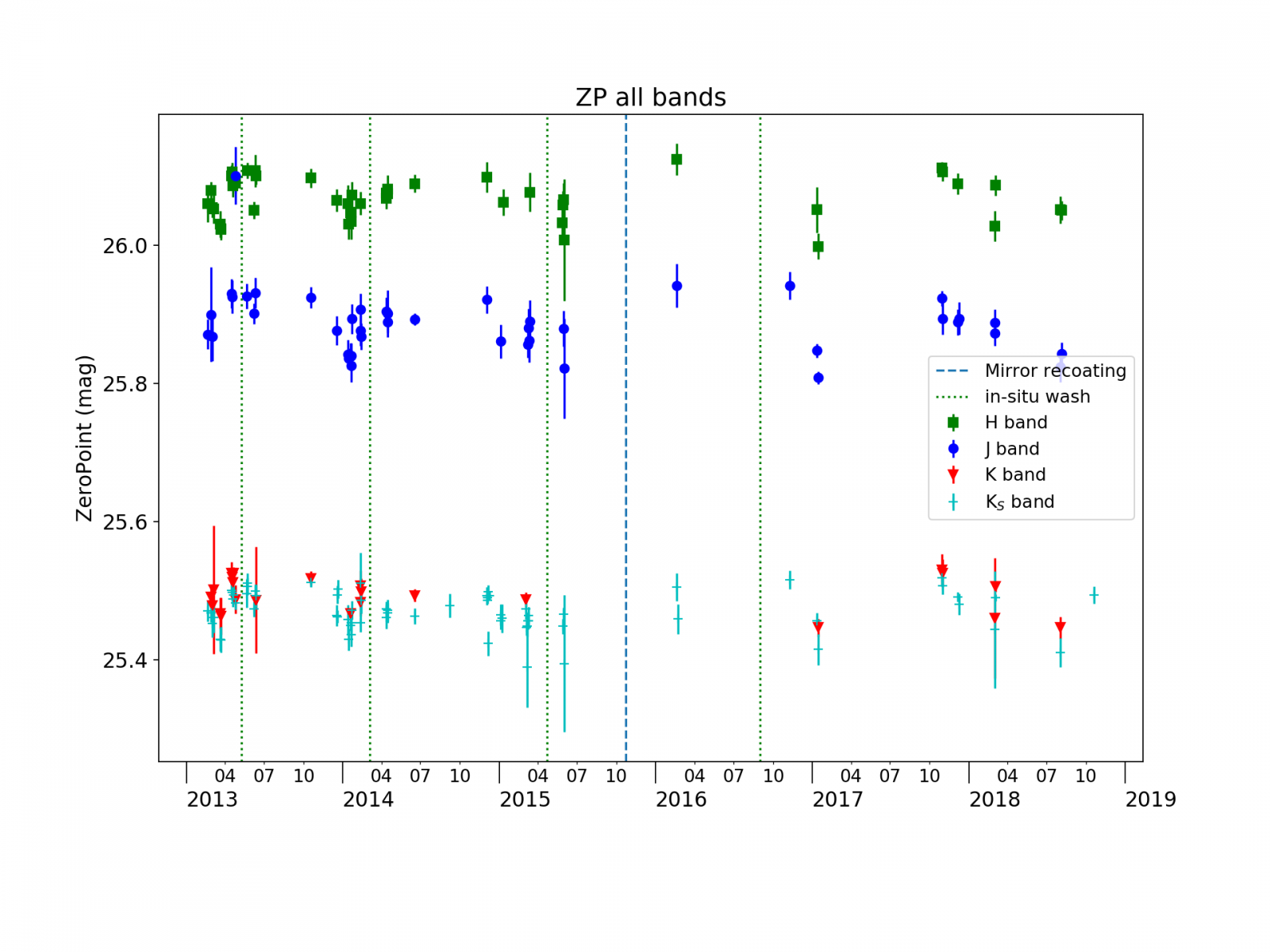
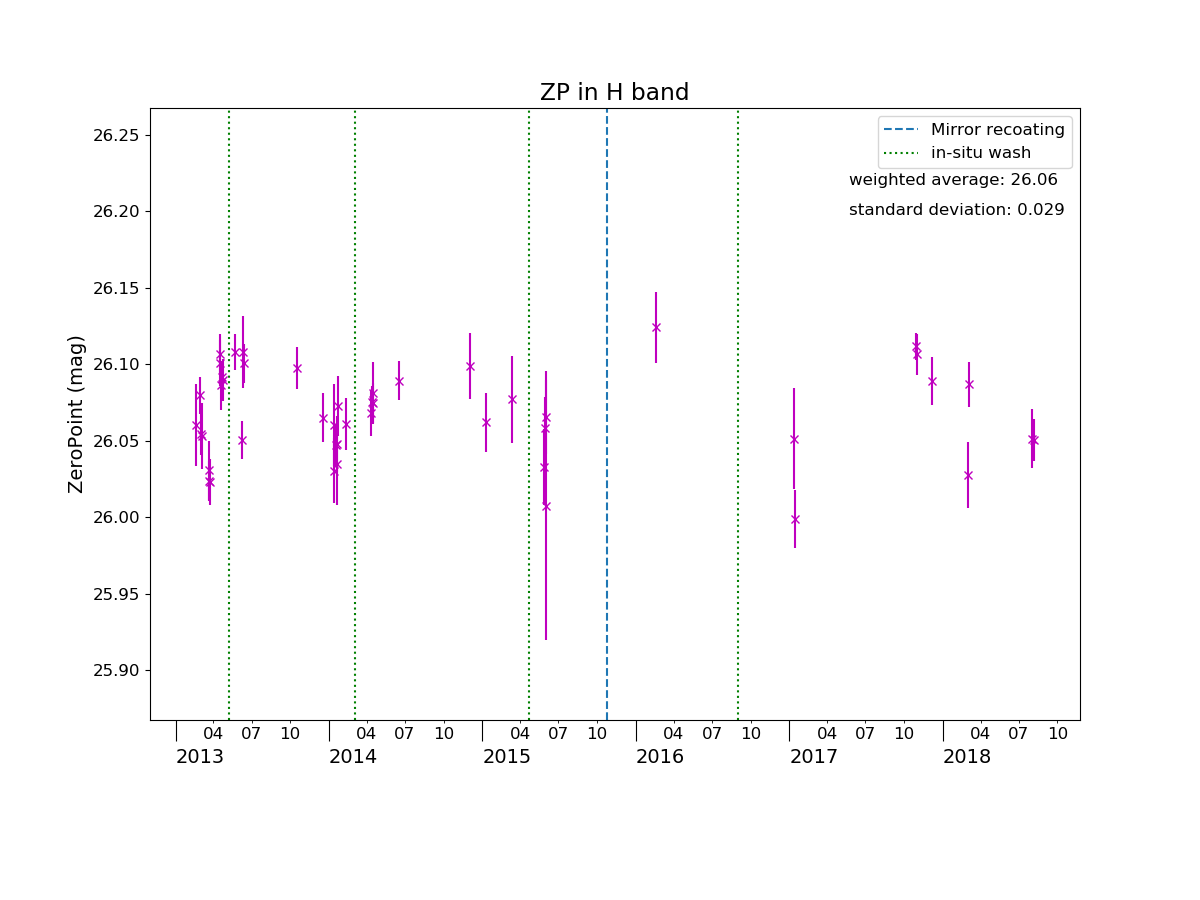
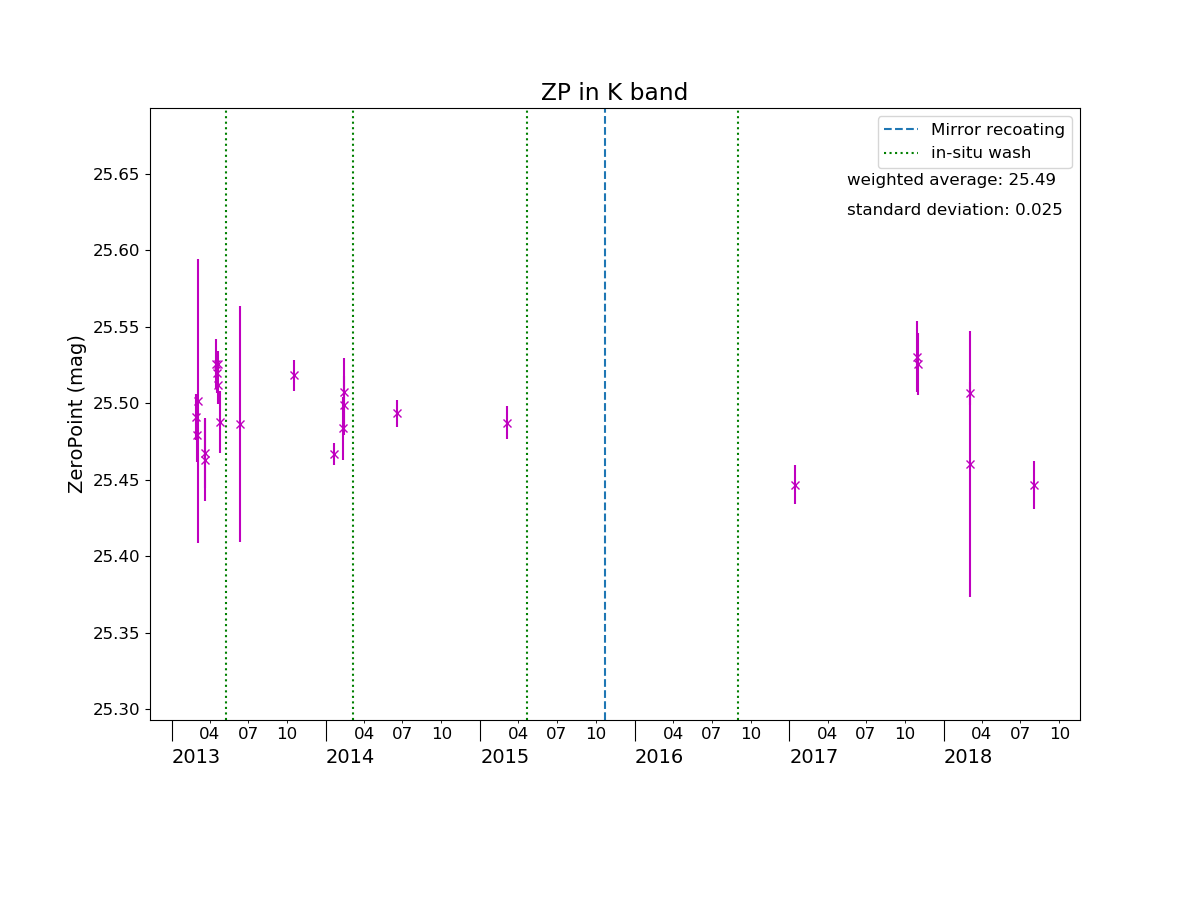
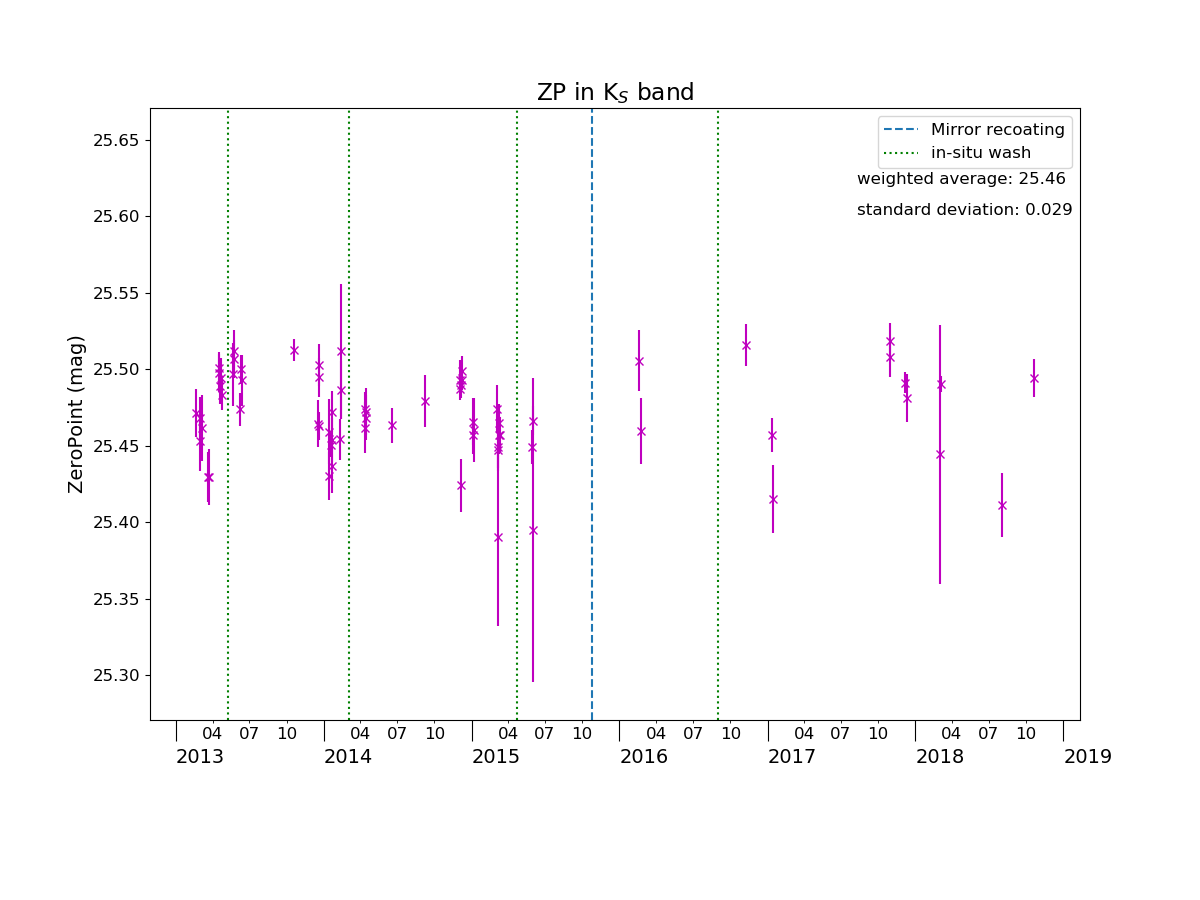
GSAOI Photometric Zero Points
Description and Goals
Every night with GSAOI science, we take images of photometric standards in the same filters as the science for that night. The photometric zero-point is added to these tables and graphs the next morning. Photometric conditions are required, but observations can be collected during twilight.
Status
First results available. More details in iPoster, presented at AAS 233, January 2019
| Band |
Table of measurements |
Plot | Monthly Averages |
|---|---|---|---|
| All bands | -- | plot | -- |
| J | link | plot | in progress |
| H | link | plot | in progress |
| K | link | plot | in progress |
| Ks | link | plot | in progress |