Announcements
Natural Guide Star (NGS)
ALTAIR with NGS uses a natural guide star (of sufficient brightness and sufficiently close to the science target, as described below) to monitor distortions in the incident wavefront and correct for them using the deformable mirror as well as provide tip/tilt corrections to the telescope's secondary mirror.
Contents
NGS guide star requirements
ALTAIR requires a guide star within 25 arcsec of the center of the field. Best performance is obtained when the guide star is much closer to the science target than this. The guide star can be the science target itself, if the target is sufficiently bright and point-like (see below).
The guide star should be as bright as possible. Two correction regimes can be distinguished:
(a) full correction regime where the best image quality can be expected; and
(b) partial correction regime where the delivered image quality degrades as the guide star magnitude increases.
Due to processing limitations of the Altair CPU, the faintest limiting magnitudes can only be reached under optimal conditions (IQ=20% or ~0.5 arcsec native seeing and CC=50%, photometric conditions). In most cases for guide stars fainter than V=13, better performance will be achieved using LGS. Limiting magnitudes for full and partial correction as a function of the guide star spectral type are given in the table below:
| V-band limiting magnitude and color for full and partial correction regimes | |||||||
| Spectral Type | A0 | G6 | K7 | M4 | |||
| V-R color | -0.2 | 0.0 | 0.4 | 0.8 | 1.2 | 1.6 | 2.0 |
| Limiting mag for full correction |
11.0 | 11.1 | 11.4 | 11.7 | 12.0 | 12.3 | 12.6 |
| Partial correction | 14.9 | 15.1 | 15.3 | 15.6 | 15.9 | 16.2 | 16.5 |
The guide star may be an extended object provided that it is bright enough with a sharp core with a FWHM < 0.6 arcsec.
Typical Performance
Assumes NIRI f/32, V=12 guide star on axis, CC50 IQ70 (clear, good seeing) conditions, and airmass = 1.2. Note that Strehl ratio decreases rapidly with decreasing wavelength and that the core FWHM is roughly constant with wavelength.
| Filter | Core Strehl ratio | Core fwhm | Halo fwhm |
| K' | 0.17 | 0.08 arc sec | 0.61 arc sec |
| H | 0.10 | 0.07 arc sec | 0.66 arc sec |
| J | 0.04 | 0.08 arc sec | 0.72 arc sec |
| Y | 0.01 | 0.08 arc sec | 0.77 arc sec |
Note that the performance will degrade with:
- Fainter guide stars
- Increased angular separation from guide star to observed object
- Extended guide "stars"
Although it is possible to use fairly faint guide stars, the combination of a faint guide star with an off-axis angle (e.g. faint guide star 25 arcsec off-axis) will lead to very poor performance. Use the NIRI ITC (with Telescope configuration set to "Altair") for individual cases; note that core FWHMs produced by the ITC are unrealistic. See the image library for examples.
NGS caveats
Here is a short list of important points to note:
- In its default configuration without the Field Lens, the Altair isoplanatic angle is relatively small. A Strehl attenuation of 50% occurs at about 7 arcsec from the guide star in K band, so do not be overly optimistic and choose guide star as close as possible from the object. Use of the Field Lens dramatically increases this 7 arcsec limit. PIs wanting to use it should review the Field Lens summary.
- Choosing a guide star that is both faint and off-axis will lead to very poor compensation.
NGS observing condition requirements
ALTAIR's performance is more sensitive to observing conditions than the other Gemini facility wavefront sensors. We recommend requesting image quality conditions equal or better than IQ=70% (i.e. FWHM in V of less than 0.8 arcsec at zenith). ALTAIR performs well in these conditions. It is possible to get some correction in IQ=85% (i.e. FWHM in V of less than 1.2 at zenith), but low Strehl ratios (around 10% in the K band) and FWHMs of about 0.1 arcsec for bright sources will result. When conditions are much worse than IQ=85%, the uncorrected size of the star exceeds the ALTAIR pupil size causing ALTAIR's control loop to diverge.
Cloud cover also adversely affects ALTAIR's performance. Cloud cover will of course reduce the magnitude of any guide star due to extinction. Clumpy clouds further reduce ALTAIR's performance as the centroid gain calculation, which relies on steady flux on the wavefront sensor will tend to produce spurious results. Under uniform cloud cover conditions such as thin cirrus, one can expect performance to degrade in line with the Gemini Cloud Cover constraints: no effect for CC=50% or better, an extinction of around 0.3 mag for CC=70%, and an extinction of about 1 magnitude for CC=80%.
We do not recommend using ALTAIR in CC=80% or worse because, in these conditions, the opacity tends to vary quickly by extreme amounts. Any guide star lock in CC=80% conditions is typically very tenuous except for the very brightest guide stars (V less than approximately 7 magnitudes).
In summary, we recommend using ALTAIR NGS in IQ=70% and CC=70% conditions or better. In some cases, such as with very bright guide stars (V magnitudes less than 7), IQ=85% / CC=70% or IQ=70% / CC=80% may be possible. However, even for the brightest guide stars, IQ=85% CC=80% is not generally possible or useful.
Note that ALTAIR LGS requires IQ=70%, CC=50%, as detailed on the Laser Guide Star page.
Laser Guide Star (LGS)
The Gemini Mauna Kea Laser Guide Star (LGS) System is designed to extend the use of ALTAIR for targets for which a bright natural guide star (NGS) is unavailable for adaptive optics correction. In general, LGS AO delivers somewhat lower Strehls than NGS AO, but it allows the use of fainter natural guide stars (because the guide star is used only for tip/tilt correction) and thus is possible over a much larger fraction of the sky than NGS AO. LGS AO produces better performance far from the guide star than does NGS AO (unless the NGS is bright and is located at or very close to the field center).
Contents
- Design
- Observing Constraints and Time-Critical Programs
- Elevation Limit
- Performance
- Using the 'open loop' focus model
Design
The Laser projects a ~10 Watt beam of coherent radiation at 589 nm into the sky. This beam excites sodium atoms at ~90 km altitude produced from the disintegration of meteors in the Earth's mesosphere.These atoms re-emit at the 589 nm wavelength producing an artificial beacon (a Laser Guide Star, LGS) on which ALTAIR can guide for high-order correction. A natural guide star is still needed for the low-order tip/tilt and focus correction, but this star need not be very bright nor very close when compared to correcting all orders. Stars down to R < 15 within 15 arcsec for high-Strehl LGS correction and R < 18.5 up to 25 arcseconds away from the science target for low-Strehl LGS correction may be used. The laser always points at the center of the field of view, but is invisible to the science detector as the ALTAIR dichroic splits the correction (optical) and science (IR) beams.
Observing Constraints and Time-Critical Programs
Laser propagation can only be done under photometric conditions and the guide loops are only stable for decent seeing. Thus, only CC=50% and IQ=70% or better observations are offered for LGS. Due to the need for technical support, the LGS is only available for certain defined periods scheduled well in advance. During LGS runs, both non-LGS queue and LGS queue programs will be executed. In general, PIs of LGS programs should request SB=Any conditions so that full moon observations can be conducted. The following table summarizes the Sky Background (SB) requirements for different natural guide-star magnitudes.
| LGS tip/tilt guide star R-band magnitude | Sky Brightness Constraint |
| R<17.5 | SB=Any |
| 17.5<R<18 | SB=80% |
| 18<R<18.5 | SB=50% |
Note that for point sources fainter than 17.5, you may wish to consider the 'open-loop' focus model technique. In 2009A, we upgraded the SFO so that its limiting magnitude more closely matches the STRAP (tip/tilt) sensor's limiting magnitude, so use of this technique for point sources should be rare in subsequent semesters.
LGS mode is available 7-14 nights per month, in queue mode only. Target lists are generated for approval by the Laser Clearing House (LCH) at Vandenberg Air Force Base approximately one week before each LGS run, using only "ready" observations. Therefore, while observations must be defined by the usual phase II deadline, any additions or alterations must be in place by the LGS target list preparation dates. These dates are listed in the "Special Instructions for Completing Phase II" link which can be found on the "Observing with Gemini" page. Limited LGS observations of Band 1 and 2 Targets of Opportunity triggered less than a week before, or during, an LGS run, are supported. Only two such targets can be observed during any LGS run, and only one on any given night. All efforts will be made to approve and observe a target within 24 hours, however a delay of two or three nights is possible.
For a detailed list of when LGS runs are scheduled, PIs should consult the current semester schedule for Gemini North (GN).
Elevation Limit
The use of ALTAIR+LGS is currently limited to targets with elevation of 40 degrees or greater (the previous 49 degree limit has been improved due to a change in the optical bench). The current 40 degree limit is a hard limit due to the optomechanical design of the instrument. Further improvements will be very difficult to make and would only take place on timescales of months or greater. These improvements are being considered. The largest science impact of the 40 degree elevation limit is that targets south of Dec=-30 and north of Dec=+70 cannot be observed. Note that the Galactic Centre is above the elevation limit for about 1.5 hours every day. Targets near the RA boundary may be observable if they are short duration observations. Targets beyond the Dec boundary cannot be observed under any circumstances due to the elevation limit.
Performance
High Strehl Correction in H, K, and L (1.6 to 2.5 microns) requires a bright (8.5 < R < 15) tip/tilt star with 15 arcseconds of the science target. Delivered Strehls are currently about 50% of that seen for NGS: 10% in H and up to 20% in K. L-band LGS has not been tested. The background in L is considerably higher with ALTAIR in the beam than with NIRI alone. However, angular resolution will be close to the diffraction limit. Observations shortward of H (such as z and J) will not produce high Strehl ratios even for bright tip/tilt stars.
Low Strehl Correction will occur with with a faint (15 < R < 18.5) tip/tilt star within 25 arcseconds of the science target or with a brighter tip/tilt star further than 15 arcseconds from the target. Delivered Strehls should be a few percent in J, up to 10% in H and K. The 25 arcsecond limit is a hard limit based on the ALTAIR optics, i.e. guide stars further than this cannot be observed with LGS.
Note: for guide stars between 18 < R < 18.5, a dark time request is required and stars between 17.5 < R < 18 require grey time. All observations shortward of H (1.6 microns) should be considered Low Strehl.
Both high-Strehl and low-Strehl correction are possible for any combination of non-sidereal and sidereal science targets and tip/tilt stars.
Guiding on extended objects: Note that galaxies with stellar-like cores may also be used for guiding. At present, only sparse data are available on which cores should work and which will fail. We currently expect guiding to work if the full width at half-maximum of the core is smaller than about 1 arcsecomd. (This corresponds to about a 1.5 magnitude drop in surface brightness per arcsec of distance from the core.) More galaxy cores near this performance limit need to be tested to refine this number.
Note that for extended sources, you may wish to consider the 'open-loop' focus model technique. In addition, extended objects are more difficult to guide on since only the core is used for guiding, not the entire flux of the source. Therefore it is suggested that limits approximately 1 magnitude brighter than those for point sources be used when trying to determine target feasibility.
Note that if your Guide Star is brighter than R < 10, you should consider using NGS. There is a risk of damage to the LGS tip/tilt wavefront sensor from such bright sources, however placement of the optional neutral density (ND) filter into the beam now allows the use of LGS on bright targets (such as calibration stars).
Performance is in general a strong function of guide star brightness. As the LGS system performance encompasses a factor 1000 range in flux, it is important that the guide star brightness be estimated accurately. We have found that the best catalog for guide star brightness is the UCAC2 catalog U magnitude, which roughly approximates the R-band observations of the tip/tilt star. The UCAC2 catalog limit is about 16th magnitude. Below this limit the USNO-B1.0 catalog is the most accurate. Note however, that the catalog has uncertainties of order 0.5 to 0.75 magnitudes so backup targets should be provided for the faintest stars.
As described above, stars brighter than R=10 must be observed using the ND filter for LGS. Most telluric standards and many photometric standards should simply be observed in NGS mode which does not require the ND filter.
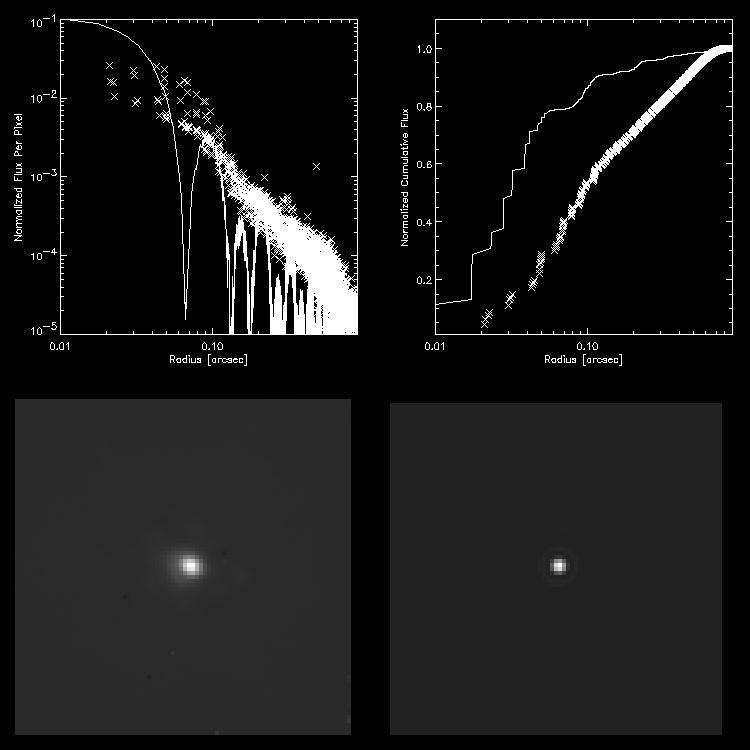
Below is an analysis of a R=13.3 magnitude star compared to diffraction limited observations (Kprime, 0.5 arc V-band uncorrected seeing, elevation 76 deg, 5 sec x 2 coadds). In the radial plots (top panels), the LGS PSF is denoted by x's and the diffraction limit is shown as a solid line. An image of the LGS PSF is shown in the bottom left panel compared to the diffraction limit in the bottom right panel (images span 1.8 arcseconds).
Using the 'open loop' focus model
As we track a target using LGS, the distance from the telescope to the sodium layer changes, as does the thickness of the sodium column along our line of sight. The altitude and thickness of the sodium layer can also change during the course of an observation. These effects change the distance to the laser guide star, which then appears de-focussed to ALTAIR. ALTAIR then tries to keep the LGS in focus, with the result that the science target becomes de-focused (the laser guide star is only at about 90km, remember, not at infinity) as ALTAIR corrects the laser guide star. To avoid this, the tip/tilt reference star is used to actively measure the focus during the observation, providing a correction to ALTAIR for the non-infinite distance to the laser guide star, and the relative changes in distance to it.
Sometimes when guiding on some faint and/or extended sources, such as a galaxy nucleus, there is insufficient signal for the focus to be measured. In these cases, we do not actively measure and correct the focus during the observation, but instead use an 'open loop' model that corrects only for the changing distance to the laser guide star as the telescope tracks, assuming a sodium layer of uniform thickness and height. We firstly 'tune' the LGS focus on a nearby bright star (typically within 6 arcminutes of the science target, due to clearance windows), and then slew immediately to the science target and begin observing.
From the experience we have had of using this technique, it seems that the atmosphere above Mauna Kea is stable enough such that the open loop model is a very good approximation on timescales of an hour or so, and there is little degradation of image quality caused by this focus model on these timescales. Therefore, if you are using a galaxy nucleus or a guide star close to the limiting magnitude, it may be necessary to use this method for your observations. This will involve an additional 10 minutes of overhead per hour or so of observation, since the focus should be 're-runed' roughly once per hour. You may also wish to include some observation of the focus star after your science observation, before and after re-tuning, in order to have an idea how significantly the focus changed during your science integration.
"Super Seeing" mode (LGS + P1)
Contents
- 1.0 Introduction
- 2.0 Performance
- 3.0 Current Instrument Testing Status
- 4.0 OT Visualization
1.0 Introduction
In 2012, we commissioned a new observing mode for ALTAIR LGS known as LGS+P1. In place of using a nearby tip-tilt focus (TTF) NGS, we have added the option of using a peripheral wavefront sensor (PWFS1 or P1) for the NGS TTF measurement. This mode does not provide diffraction-limited resolution, but instead gives “super-seeing” by reducing the natural seeing PSF FWHM by a factor of 2-3. The major benefit of this seeing-improver mode is that it increases the LGS sky coverage to almost 100%, providing a significant level of PSF correction for a wide variety of applications.
To enable LGS+P1, the P1 wavefront sensor was upgraded, replacing the 6 x 6 lenslet array with a 2 x 2 array, thus increasing its sensitivity. A narrow band (FWHM = 10 nm) notch filter was installed to block out the Rayleigh backscatter for the laser propagation, while still allowing the standard set of filters to be used.
Currently, LGS+P1 has been commissioned with NIRI in f/14 and f/32 configurations and with NIFS. It is important to know that significant flexure issues remain (see section 3.0 below) which limit the use of this mode on targets that are not visible during acquisition and also drastically limit the amount of time that a target can remain in a spectroscopic slit. We are currently working to resolve these issues.
2.0 Performance
2.1 On-Axis Performance
The performance on-axis will improve the image quality by a factor of 2-3 over the natural seeing. We have tested this in a small variety of seeing conditions, as shown in Figure 1.
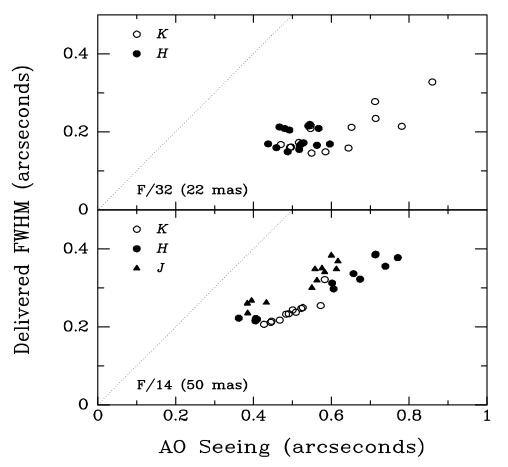
Figure 1: Delivered image FHWM for both NIRI f/14 and f/32 exposures for a range of natural seeing conditions.
Figure 1 shows the LGS+P1 mode performance measured from individual exposures for two nights worth of test data taken under a range of seeing conditions for both NIRI f/14 (texp = 30 sec) and f/32 (texp = 10 sec) configurations. These preliminary results indicate that use of LGS+P1 improves the “effective seeing” from IQ70 to IQ20.
The bottom panel illustrates that K’-band correction is better than H and J. More data are required to assess the effective IQ benefits for excellent seeing cases. Note that for all these data the P1 guide star (using the R filter) was ~ 5’-6’ from the field center.
2.2 Field-of-View PSF Variability
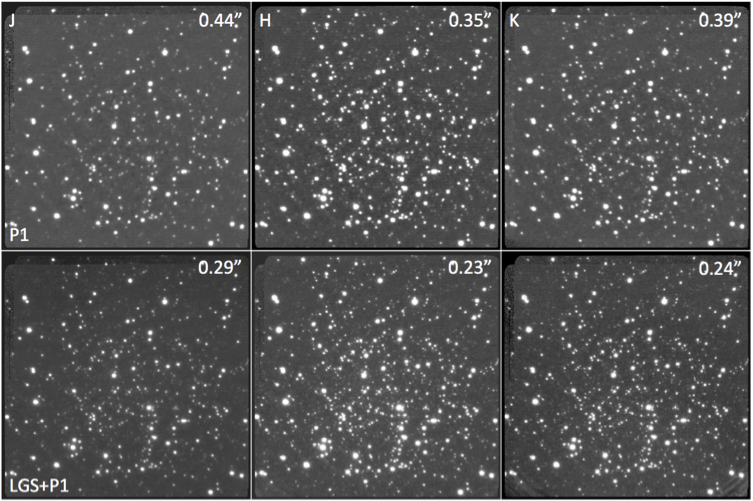
Figure 2: NIRI F/14 images of the central region of NGC 2419 for seeing-limited P1 guiding (top) and LGS+P1 (bottom) for (left-to-right) J, H, and K’ bands. Each image is the co-added sum of four 30sec exposures.
Figure 2 compares a sequence of seeing-limited images with P1 guiding (i.e. non-LGS native seeing) to corresponding LGS+P1 images showing the decrease in the mean FWHM across the images for three wavebands. In f/14 mode the FoV is 51.2” and the PSF variability, as measured by the FWHM dispersion, across the field is ~ 6% for both seeing-limited and corrected images. For these data the P1 guide star was ~ 5.6’ from the field center. For the corrected data, the ALTAIR estimated V-band seeing was 0.40”, 0.40” and 0.46” when the J, H and K images were taken, respectively.
2.3 Encircled Energy (NIFS)
Figure 3 shows the encircled energy fraction as a function of radius in the NIFS PSF for different guide modes. These are empirical measurements, taken under similarly good seeing conditions. The 'NGS' case used a bright (R~10) on-axis guide star. The 'LGS' case used a moderately bright on-axis tip/tilt star (R~14), and the 'LGS-P1' case used an R~13.3 guide star some 6 arcminutes off-axis. The 'No AO' case used an R~10.7 guide star with the 'P2' guider. Table 1 provides a summary of the PSF parameters and natural seeing conditions for the different observations.
| Mode: | NGS | LGS | LGS-P1 | No AO |
| PSF FWHM (diameter): | 0.10" | 0.12" | 0.13" | 0.30" |
| 50% encircled energy radius: | 0.11" | 0.13" | 0.16" | 0.21" |
| 80% encircled energy radius: | 0.39" | 0.43" | 0.42" | 0.43" |
| Energy fraction within NIFS spaxel: | 34% | 26% | 18% | 9% |
|
Seeing conditions (FWHM): |
0.33" | 0.31" | 0.37" | 0.40" |
Table 1: Parameters of K-band NIFS PSFs shown in Fig.3, giving the empirical Full Width at Half Maximum (not from a model fit); the 50% and 80% encircled energy radii; the fraction of energy falling in a circle of equivalent area to a single NIFS spaxel (0.103" x 0.042"); and the optical (approximately V-band) seeing conditions during the observation.
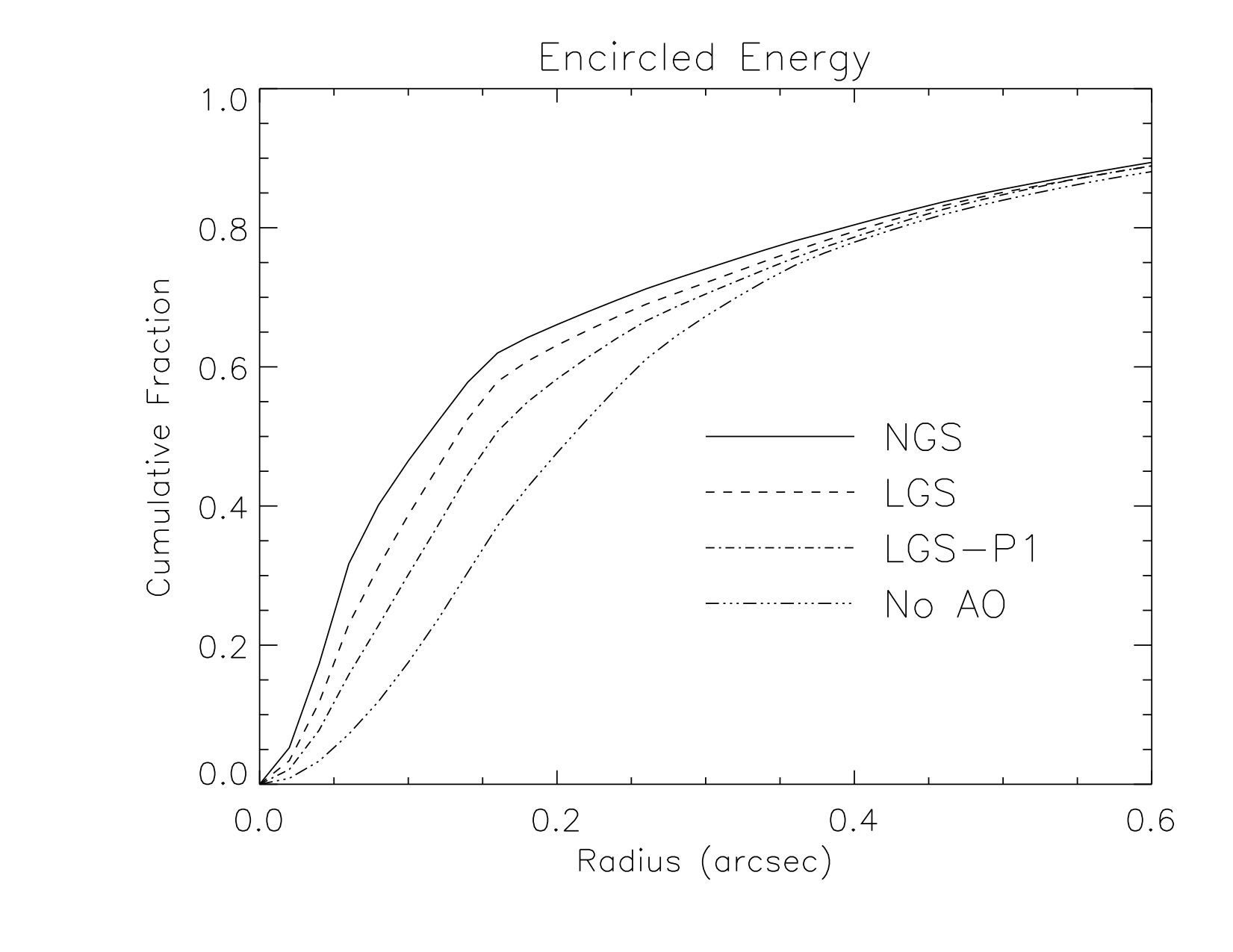
Figure 3: NIFS PSF encircled energy for various guide configurations."NGS" is classic natural guide star AO with a bright on-axis star. This should give the best AO correction. "LGS" uses a moderately bright (R~14) on-axis star for tip/tilt and focus corrections, and the on-axis laser guide star (LGS). "LGS-P1" uses the LGS on-axis to correct high-order terms, and an R~13.3 guide star on the peripheral wave-front sensor some 6 arcminutes off-axis. "No AO" is for a similar peripheral guide star, but with no on-axis laser correction. Table 1 provides the PSF metrics.
2.4 Sky Coverage
The limiting magnitude of P1 is R ~ 14 so that the guide star limit is brighter than for the conventional LGS mode, but this is more than offset by P1's much larger patrol field. Figure 4 shows the predicted sky coverage as a function of galactic latitude for the LGS+P1 configuration (red) compared with the conventional LGS mode (black).
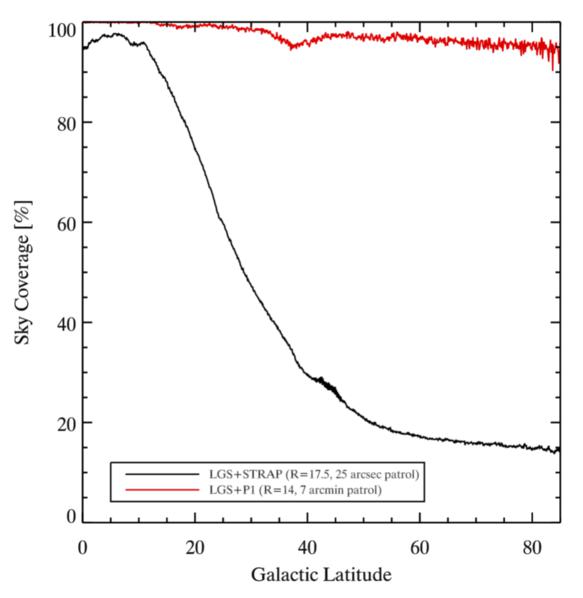
Figure 4: Comparison of estimated sky coverage for LGS+P1 (red) compared with conventional LGS (black). Note that sky coverage refers to the percentage of sky with guide stars above elevation 40 at Gemini North.
3.0 Current Instrument Testing Status
It is expected that LGS+P1 mode will be used with the NIR instrument suite at Gemini North which comprises NIRI, NIFS and GNIRS. Note that for all instruments SNR estimates can be obtained by using the non-AO Integration Time Calculator (ITC) assuming an IQ = 20% and CC=50% (the CC conditions for Laser use). There are still a significant number of software modifications needed to reach operational efficiency.
Currently, the issue with the greatest impact to science is that significant flexure is seen between the P1 tip/tilt sensor and the various science cameras. This flexure has been measured to be of order 0.4 arcsec per 30 minutes with NIRI, which is similar to the full width at half maximum (FWHM) of the point spread function (PSF). The implications of the current flexure is that slit spectroscopy and blind offsetting are limited by this magnitude of flexure. Thus, for spectroscopy we require that a continuum source be visible (S/N > 1 per spectral element) somewhere in the science frame for typical exposure times (~15 minutes).
In addition, we cannot support blind offsetting (i.e. invisible targets) at this time, since we have no way to independently check if the target has moved out of the science beam nor is the P1 probe mapping reliable for large offsets at this time. This limitation is one of our highest priority issues. However, since this is a work in progress, part of the shared risk nature of this mode includes the possibility that we may not be able to implement the flexure model, or the magnitude of flexure may be larger or more difficult to correct than expected. In addition, this flexure may significantly complicate reduction as there may be a ~0.2 arcsec image motion every 15 minutes.
Operational efficiency is currently significantly lower than typical LGS. This is because there is significant operational software work to be done to reduce acquisition times to the current typical LGS overheads. There is the risk that overheads may be larger than expected, which is part of the nature of the shared risk of the mode. Currently, we ask that PIs use the typical LGS overheads listed elsewhere, but be aware that fewer targets or less on-source time may be a reality. Proposals with scientifically viable contingencies will have an advantage in the case that operational efficiency is still reduced when the semester starts.
To estimate exposure times and feasibility of targets (i.e. that they are visible in the science instrument), we ask that PIs use the Integration Time Calculator (ITC) for the instrument of interest in non-AO mode assuming IQ=20%, CC=50% conditions. Very roughly, the ITC suggests that for broadband point source imaging, there must be a target in the field with magnitude 22 or brighter to satisfy the flexure requirements (S/N > 5 in a typical exposure of a few minutes). For spectroscopy, the limits are about magnitude 20 (S/N > 1 per continuum spectral element).
For extended sources or narrow-band emission lines, PIs should estimate target viability by consulting the ITC directly to ensure that the observer can acquire the target (or another bright target in the same slit for GNIRS) by direct imaging and that the spectra are visible in each exposure so that any movement out of the slit (for GNIRS) or within the IFU (for NIFS) can be tracked.
3.1. NIRI
LGS+P1 has been tested for f/14 and f/32 in the J, H and K bands. It will be available for use in adaptive optics imaging mode as described in the NIRI imaging pages.
3.2 NIFS
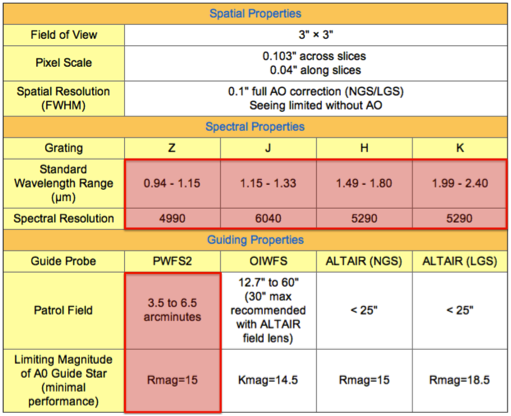
The NIFS top-level spectroscopy page gives information on the spectral and guiding properties. This table is reproduced below and for use with LGS+P1 use the PWFS2 patrol field and limiting guide star magnitude (highlighted). The highlighted region of the spectral properties indicate the grating modes which need to be commissioned.
3.3. GNIRS
GNIRS has not yet been commissioned with the LGS+P1 mode. This is available in shared risk mode for spectroscopy using the long and short cameras in cross-dispersed and long-slit modes and also for imaging for X – K bands.
4.0 OT visualization
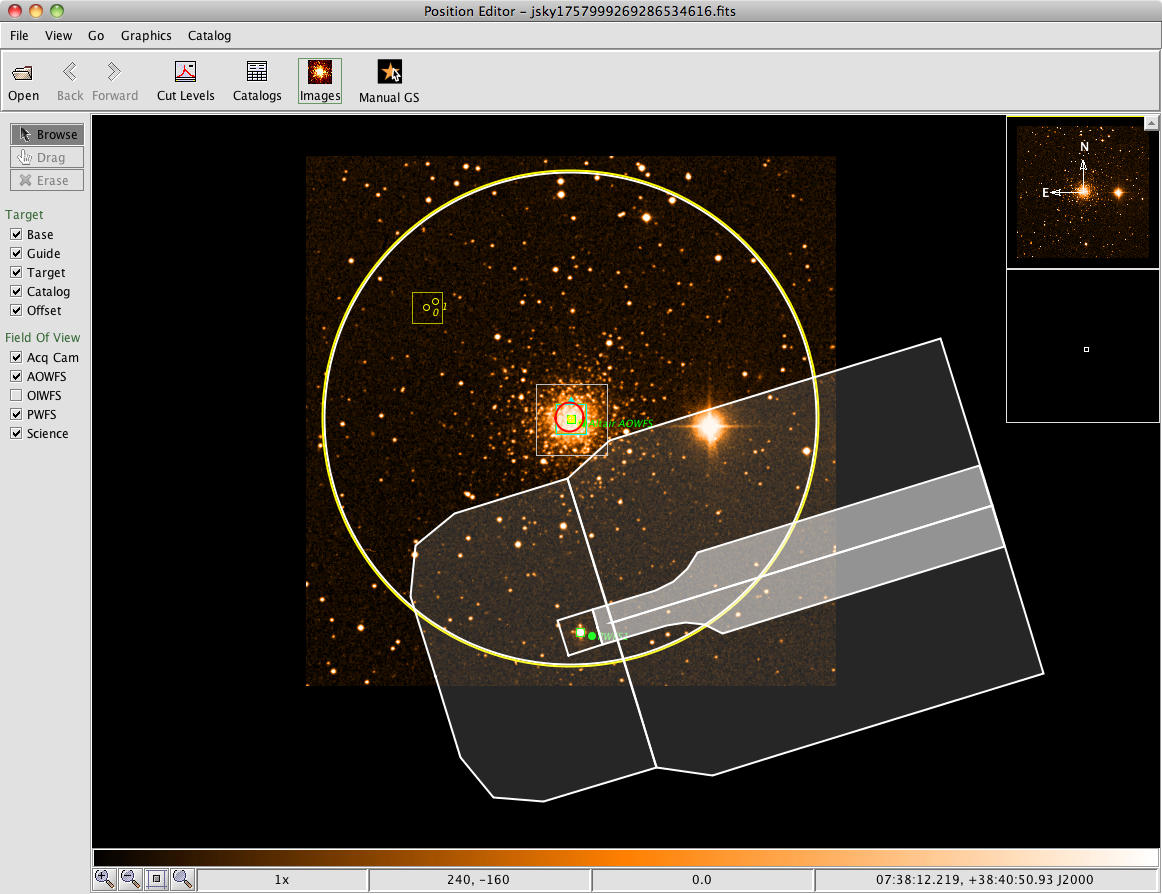
To help visualize the geometry of the field, we include this example image from the Observing Tool. In the image, the laser guide star appears in the center of the globular cluster and the P1 tip/tilt/focus star is towards the bottom of the image, about 7 arcminutes from the science target. The red circle shows the ALTAIR patrol field used for traditional (STRAP) LGS.