Change page style: 

FLAMINGOS-2

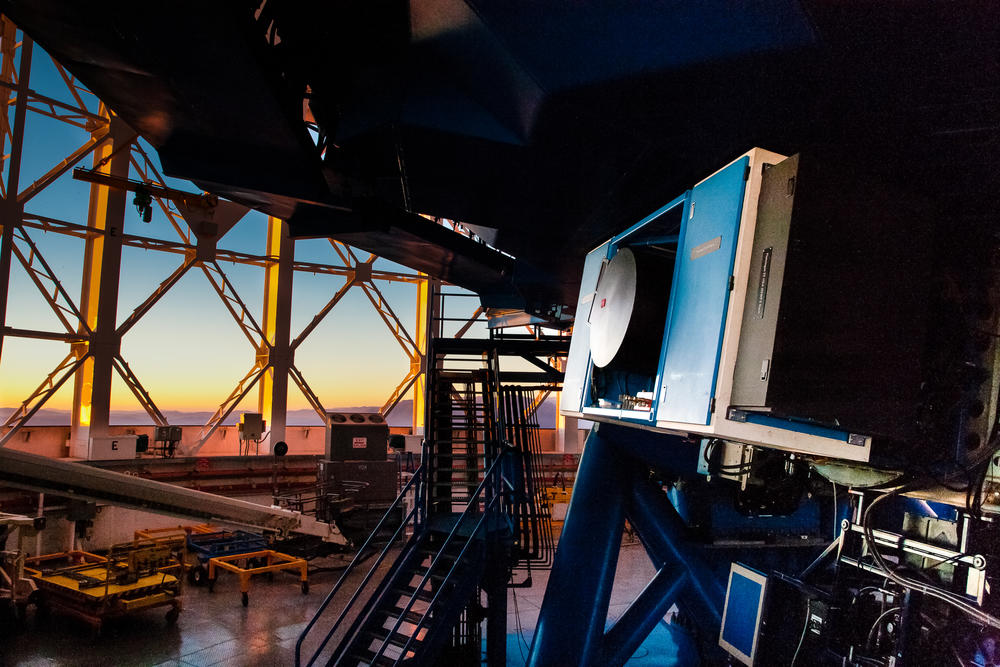
FLAMINGOS-2 is a Near-Infrared wide field imager and multi-object spectrometer for use on Gemini-South. It was constructed by the University of Florida Astronomy Department. FLAMINGOS-2 was delivered to Gemini in July 2009. The instrument is undergoing a period of characterisation and commissioning before it will be available for scientific use. More details and an official anouncement about its availability to the community will be posted towards the end of instrument commissioning (first half 2010).

FLAMINGOS-2 will provide Near Infrared (0.95-2.4 micron) imaging capabilities over a 6'.1 diameter circular field, and multi-object NIR spectroscopy at resolutions R = 1200-3000 for objects within a 2'x6' quasi-rectangular field. FLAMINGOS-2 will also also work in conjunction with the facility multi-conjugate adaptive optics (MCAO) system to provide imaging and MOS spectroscopy of the 2' MCAO corrected field. A dual-etalon tunable filter system has also been proposed and is being developed to offer tunable narrow-band imaging capabilites for FLAMINGOS-2 with the MCAO system.

For guiding, FLAMINGOS-2 has an on-instrument wavefront sensor (OIWFS) to provide guiding information to the telescope by measuring a nearby star. The OIWFS contains a 80x80-pixel Marconi CCD sensitive from 0.3 to 0.85 microns.

The current web pages present an overview of FLAMINGOS-2's expected capabilities in order to support long-range planning in the observing community. Further information will be added after FLAMINGOS-2's actual performance is measured during acceptance testing and commissioning.

The Instrument Scientist for FLAMINGOS-2 is Percy Gomez.


Announcements


During the lab checkouts of Flamingos-2 we discovered that the cosmetics of the Hawaii-2 detector have changed. We detected a large feature in the upper right quadrant (covers 30%) that was not present before. The affected pixels have characteristics similar to the response of dead pixels. We are trying to determine the origin of this feature. At the same time we are placing an order with Teledyne for a replacement Hawaii-2 detector. We will post new information as soon as it becomes available.