Announcements
Detector Array
The basic properties of NIRI's array are given here, as well as the problems that occasionally affect the quality of the raw data.
| Array | Aladdin InSb (Hughes SBRC) |
| Pixel format | 1024x1024 27-micron pixels |
| Spectral Response | 1 to 5.5 microns |
| Dark Current | 0.30 e-/s/pix (shallow well) 1.82 e-/s/pix (deep well) |
| Read Noise (low background mode) | 10 e-/pix |
| Read Noise (medium background mode) | 35 e-/pix |
| Read Noise (high background mode) | 70 e-/pix |
| Gain | 12.3 e-/ADU |
| Well depth (near-IR, -0.6V) | 200,000 e- |
| Well depth (thermal-IR, -0.9V) | 280,000 e- |
| Quantum efficiency | about 90% |
| Flat field uniformity | +/-18% (VIEW) |
| Flat field repeatability | +/-0.3% |
| Bad pixels1 | Shallow-Well ~ 1.9% and Deep-Well ~ 2.3% |
| Residual image retention2 | 0.5-1% of a bright (saturated) source in the next frame |
| Centered Sub-array dimensions | 768x768, 512x512, 256x256 pixels |
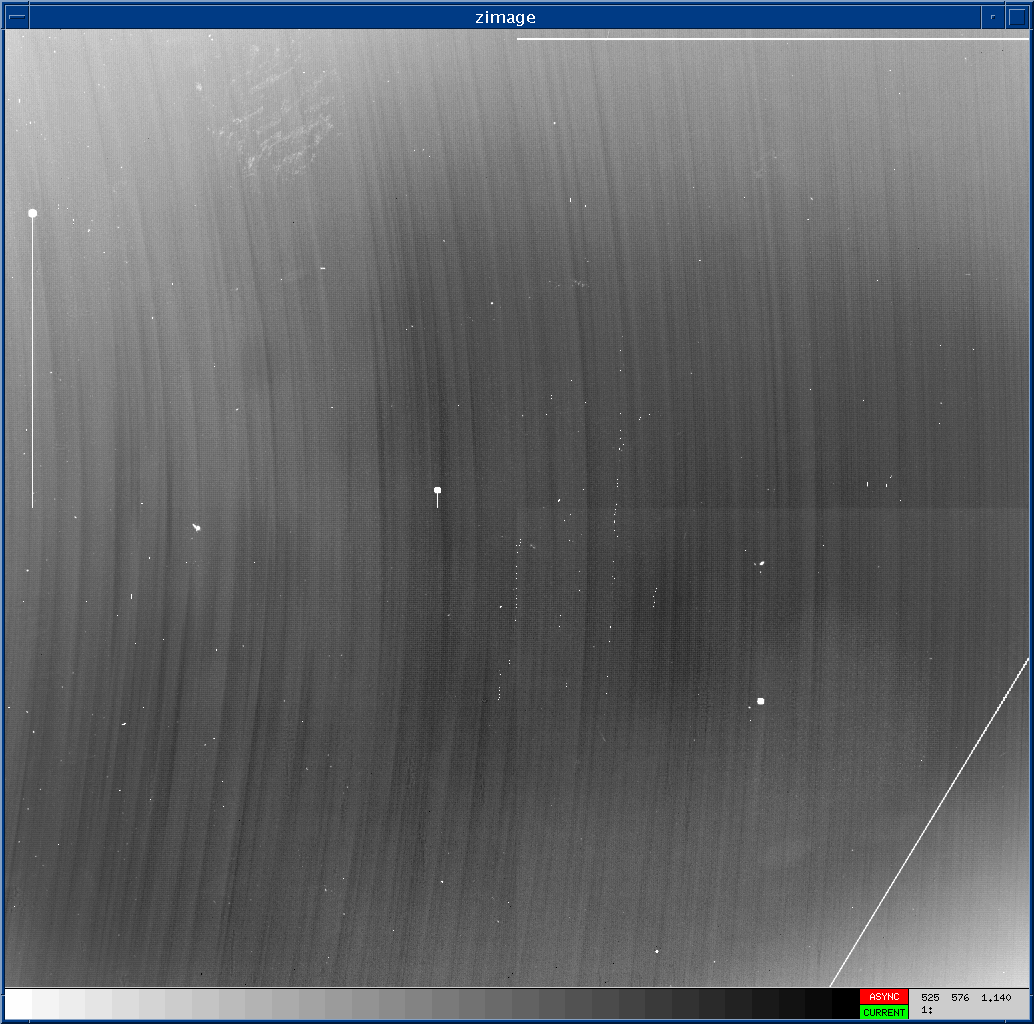
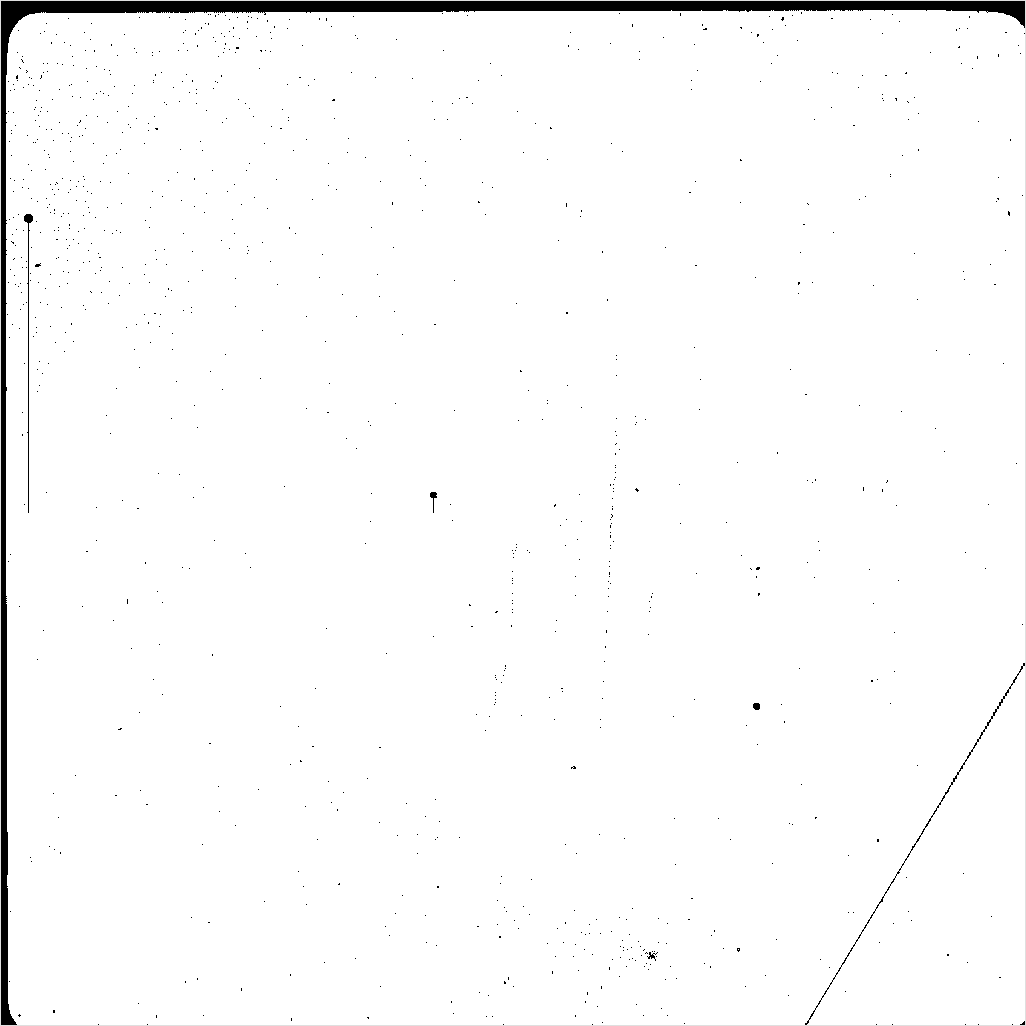
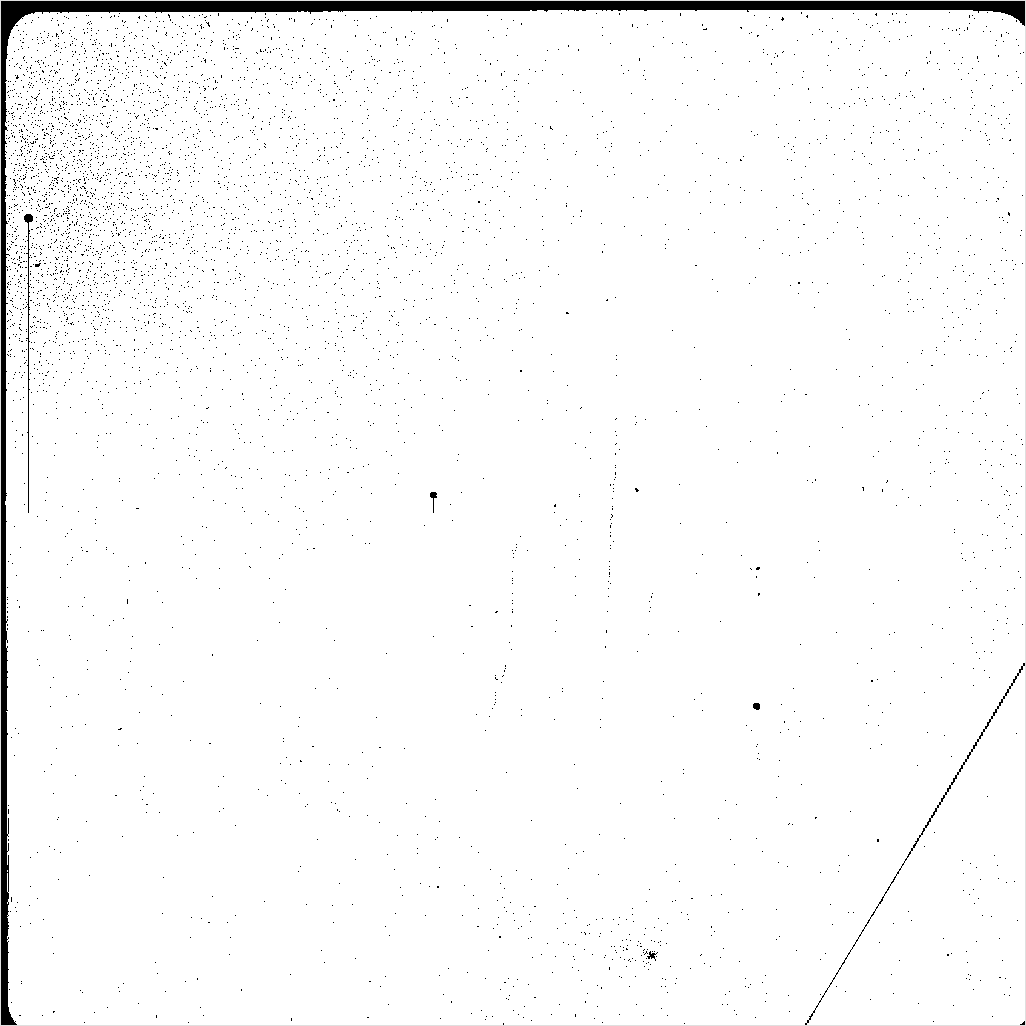
The array has nicely uniform response and very low dark current. Various size centered subarrays may be read out instead of the full 1024x1024 array. The bias voltage may be adjusted to modestly increase the well depth for thermal IR (L and M band) observations.
1Additional bad pixels appear when using the 256x256 subarray. These pixels are the last 8 pixels read out in each quadrant, yielding a bad block of 32 pixels (16 pixels wide x 2 pixels high) located exactly in the center of the detector. Because of this feature, perfectly centering targets on the array is not recommended in 256 subarray mode.
2Image persistence is small in this array, but saturated or nearly saturated images will leave a ghost in one or two subsequent frames. The persistence of a very bright source is typically 0.5 to 1% in the next frame and less than 0.1% by the third frame.
The photo below shows the Aladdin array mounted on this focus stage.
![[NIRI Detector Mount]](http://www.gemini.edu/sciops/instruments/niri/overview/detector-mount.jpg)
Below is a close-up photo of the Aladdin array.
![[NIRI Aladdin Detector]](http://www.gemini.edu/sciops/instruments/niri/overview/detector.jpg)
Read Modes
Three read modes have been defined to optimize use of the array. For high background environments (e.g., in the thermal IR), the array is read once at the beginning and once at the end of the exposure and the difference is recorded. In medium background situations (e.g., f/6 broad band JHK imaging) the same basic mode is used, but the beginning and end reads are digitally averaged 16 times. In low-background observations (e.g., f/32 observations, 1-2.5um narrow band imaging and 1-2.5um faint object spectroscopy), the array is read 16 times at the beginning and the end of the exposure, with the above digital averaging also taking place during each read.
Saturation
The saturation level in a single coadd and low-noise read pair is about 16,000 ADU (although the exact well depth varies with position on the detector and intensity of the incident radiation). Because of the way the array is operated (reset-read-read), progressively brighter sources will approach saturation and then begin to get FAINTER as the array begins to saturate in the time between the reset and the first read. Saturated stars often show a central hole, sometimes even becoming negative in the core.
Linearity
The linearity of the array is best (a few percent deviations) at low- to medium-flux levels and with exposures longer than a few seconds. When the exposures are very short (<1s) or when the well reaches approximately >70% of the full well the non-linearity becomes severe. Observations should therefore attempt to stay in this optimal regime. See the Data Format & Reduction > Warnings section on how to deal with non-linearity.
First Frame
When starting exposures after changing the detector configuration (well-depth, read mode, exposure time, etc) the background or dark current level is different, possibly due to image persistence after saturating the array (NIRI has no shutter). This means that the first exposure of each new sequence will show poor background subtraction and will likely need to be rejected. We therefore recommend that sequences include an extra step (either at the beginning, or repeat the first position at the end, or simply include N+1 different offsets). Short exposures that are not background limited (e.g., standard star measurements) are usually fine without an extra exposure. If using multiple coadds you can add a single exposure of the same integration time before the offset iterator. For example, if you are using 15 second exposures and 4 coadds, you could add one or two 15 second exposures to the observation before the offset iterator. Note that pauses in the sequence and changing the exposure time can induce a new first frame, so you may also see the first frame after changing filters.
Quadrant Boundaries
Quadrant boundaries are sometimes visible due to a mismatch in the background level of exposures which are not background dominated. However, background-limited exposures show no discontinuity, and no special precautions are necessary to avoid placing objects on the boundaries.
Crosstalk
There is column crosstalk in columns 534 and 535 in the bottom right quadrant (rows 1 to 512), and these pixels will always have very similar values. Stars which fall on these two columns will therefore appear slightly elongated or boxy.
Imaging Filters
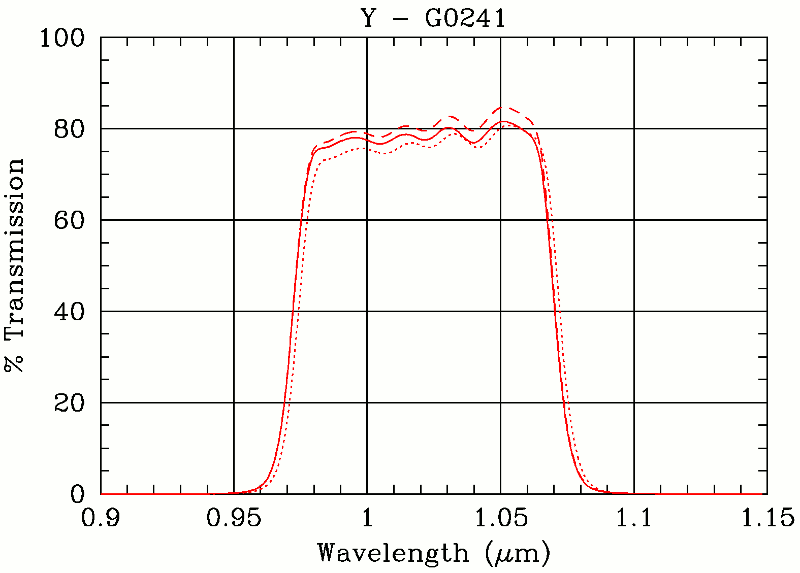
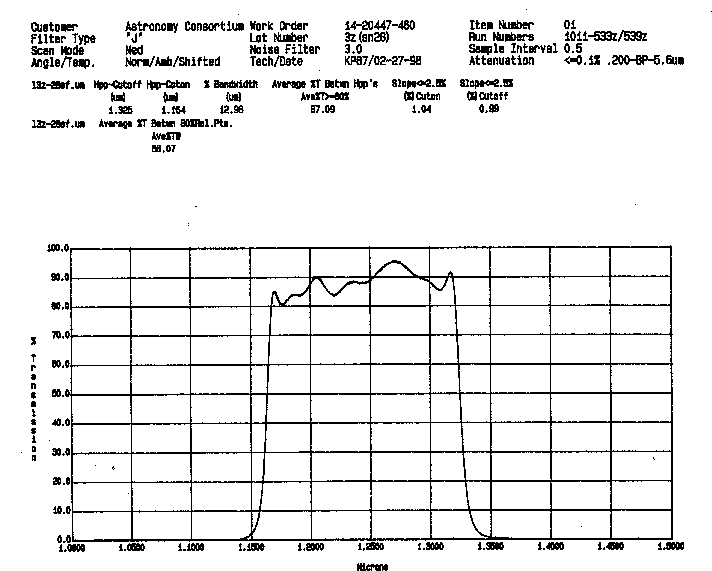
NIRI contains two filter wheels (FW1, FW2) and a pupil mask wheel (FW3) with room for ~25 broad-band and narrow-band filters. The table below provides detailed information about the NIRI imaging filters and their availability. The Gemini identification number for each filter is recorded in the header of the data files.
| Filter Name | Central Wavelength (microns) |
Coverage (microns or dl/l) |
Gemini ID | Transmission Curve (click for graph) |
Transmission Data* | Currently In Dewar? | Filter Wheel |
| Broad-band filters | |||||||
| Y1 | 1.02 | 0.97-1.07 | G0241 | yes | warm, cold, cold+PK50 | yes | FW3 |
| J | 1.25 | 1.15-1.33 | G0202 | yes | warm | yes | FW1 |
| H | 1.65 | 1.49-1.78 | G0203 | yes | warm | yes | FW1 |
| H-K notch | - | 1.45-1.76;1.93-2.29 | G0236 | yes | warm | no | - |
| K | 2.20 | 2.03-2.36 | G0204 | yes | warm | yes | FW1 |
| K(short) | 2.15 | 1.99-2.30 | G0205 | yes | warm | yes | FW1 |
| K(prime) | 2.12 | 1.95-2.30 | G0206 | yes | warm | yes | FW1 |
| L(prime) | 3.78 | 3.43-4.13 | G0207 | yes | warm | yes | FW1 |
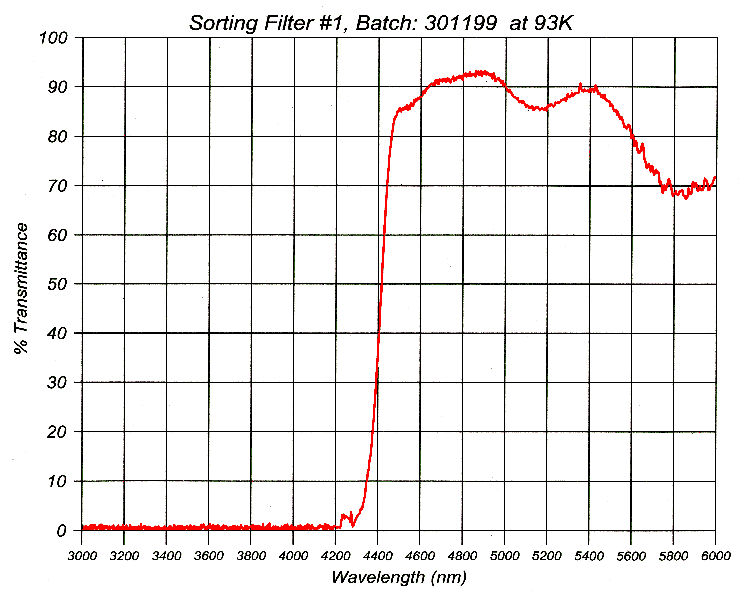
| M(prime) | 4.68 | 4.55-4.79 | G0208 | yes | warm | yes | FW1 |
| Line and feature (narrow-band) filters | |||||||
| J-continuum1 | 1.065 | 0.8% | G0239 | yes | warm | damaged | - |
| HeI | 1.083 | 1.5% | G0234 | yes | warm | yes | FW3 |
| Pa(gamma)7 | 1.094 | 1.5% | G0240 | yes | warm | yes | FW3 |
| J-continuum1 | 1.122 | 0.8% | G0235 | no | cold | damaged | - |
| J-continuum1 | 1.207 | 1.5% | G0232 | yes | warm | yes | FW3 |
| Pa(beta)1 | 1.282 | 1.5% | G0221 | yes | warm cold | yes | FW3 |
| H-continuum1 | 1.570 | 1.5% | G0214 | yes | warm cold | yes | FW3 |
| CH4 (short)1,5 | 1.58 | 6.5% | G0228 | yes | warm cold | yes | FW3 |
| CH4 (long)1,5 | 1.69 | 6.5% | G0229 | yes | warm cold | yes | FW3 |
| [FeII]1 | 1.644 | 1.5% | G0215 | yes | warm cold | yes | FW3 |
| H2O ice | 2.045 | 8.31% | G0242 | yes | warm | yes | FW2 |
| K-continuum | 2.0975 | 1.31% | G0217 | yes | warm cold | yes | FW2 |
| H2 1-0 S(1)3 | 2.1239 | 1.23% | G0216 | yes | warm cold | yes | FW2 |
| Br(gamma) | 2.1686 | 1.36% | G0218 | yes | warm cold | yes | FW2 |
| H2 2-1 S(1) | 2.2465 | 1.34% | G0220 | yes | warm cold | yes | FW2 |
| K-continuum | 2.2718 | 1.55% | G0219 | yes | warm cold | yes | FW3 |
| CH4 ice | 2.275 | 6.59% | G0243 | yes | warm | yes | FW2 |
| CO 2-0 (bh)4 | 2.289 | 1.22% | G0225 | yes | warm cold | yes | FW2 |
| H2O ice | 3.050 | 5% | G0230 | yes | warm | yes | FW2 |
| hydrocarbon | 3.295 | 1.5% | G0231 | yes | warm | yes | FW2 |
| Br(alpha) cont | 3.990 | 3.95-4.02 | G0237 | yes | warm | yes | FW2 |
| Br(alpha) | 4.052 | 4.02-4.09 | G0238 | yes | warm | no | - |
| PK-50 blocker6 | N/A | 0.8-2.6 | G0201 | yes | warm | yes | FW1 |
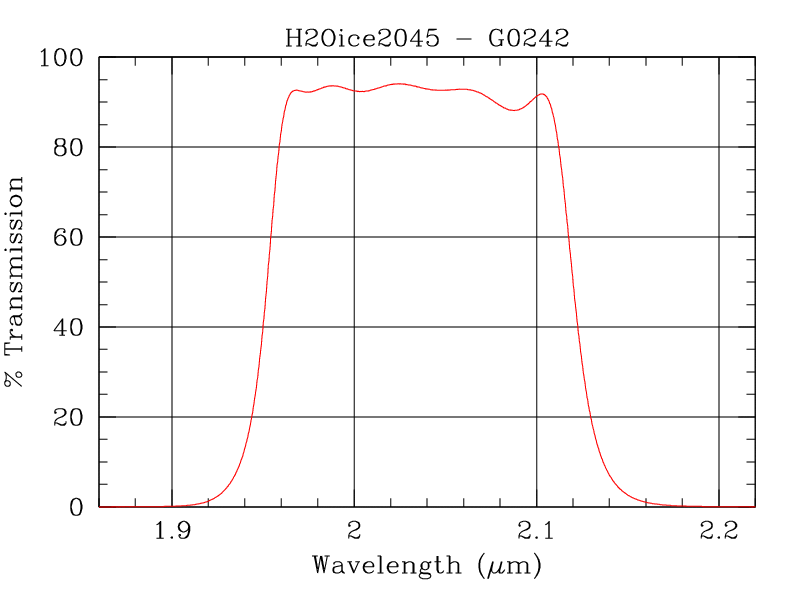
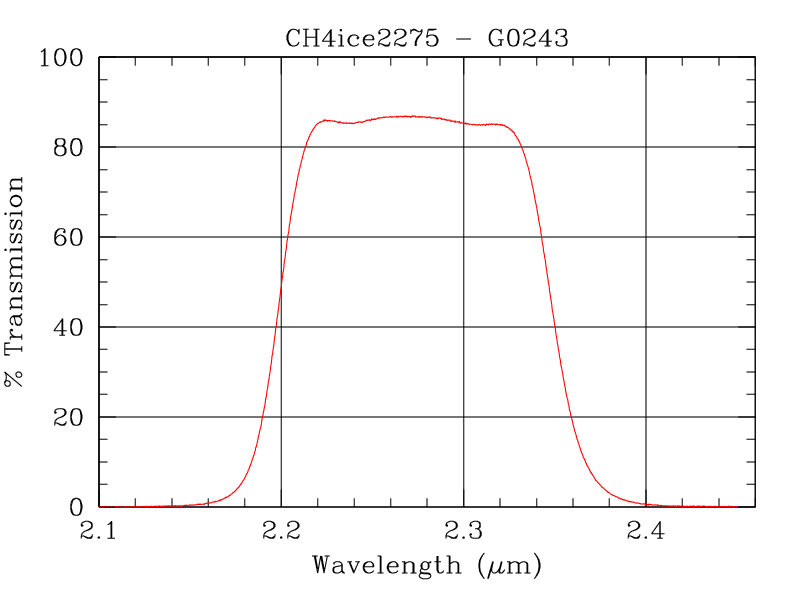
* Some filter scans have been done warm (covering the range from 0.8 to 3.3 microns). Cold scans taken in NIRI using the grisms are available for some filters are listed as ‘cold’ . Narrow band filter bandpasses depend on the temperature of the scan and angle with respect to the incident light. Narrow band filters were scanned at approximately a 5 degree angle.
1 Crossed with the PK-50 blocker filter to avoid long-wavelength contamination (this may not be included in the posted transmission data or graph; see each filter page for more details).
2 Crossed with the K(prime) filter to avoid long-wavelength contamination (this is not included in the posted transmission data or graph).
3 Crossed with the K filter to avoid long-wavelength contamination (this is not included in the posted transmission data or graph).
4 The CO 2-0 filter is not well-centered on the CO band; it includes considerable continuum shortward of the 2-0 band head.
5 "CH4 short" and "CH4 long" filters have considerable overlap and "CH4 long," intended to sample the continuum shortward of the methane absorption in T dwarfs, extends far into the T dwarf methane absorption band. It may be preferable to substitute the "H-continuum" filter for "CH4 short." If you contemplate using any of these filters, check the filter profiles carefully.
6 The PK50 long-wavelength blocker goes gradually from nearly completely transmissive at the blue end of the K window to opaque at the red end. This blocker is used to block some red leaks in the other filters.
7 The Pa(gamma) filter currently installed in FW3 is currently expected to be replaced by the Wollaston polarimetric analyser prism for GPOL commissioning/science verification/science observations for semester 2022B. It is anticipated that all filters currently installed in FW1 and FW2 may potentially be used in combination with the Wollaston for simple (unmasked) imaging polarimetry.
Y Filter
J Filter
Comments: Filter scanned warm and normal to the light path. Data are shifted to the performance expected when cold.
H Filter
Comments: Filter scanned warm and normal to the light path. Data are shifted to the performance expected when cold.
![[H transmission curve]](http://www.gemini.edu/sciops/instruments/niri/filters/niri-h.gif)
Other components
Entrance Window
|
The NIRI entrance window is made of CaF2 and is 180mm in diameter and 20mm thick with radius of curvature of 4000mm on both surfaces. The outer window surface is at ambient temperature/pressure while the inner surface will reach cryogenic temperatures at vacuum (<10^-5 torr). The window provides a clear aperture of 145mm diameter and has a wedge tolerance specification of <0.5 arcminutes. The outer surface is anti-reflection coated for the 1-5.6um wavelength range. In the photograph below, the entrance window aperture is shown covered by a plexiglass disk to keep moisture from condensing on the CaF2 window during testing at sea-level. This will be removed when NIRI is in use on Gemini. Through the window can be seen the focal-plane pin-hole mask used in image quality characterisation. ![[NIRI Entrance Window]](http://www.gemini.edu/sciops/instruments/niri/overview/niri-entwin.gif) |
Beam-splitter Wheel
|
The NIRI beam-splitter wheel contains three beam-splitters to direct the science beam and OIWFS (On-instrument wavefront sensor) beam to the appropriate on-board instruments. The beam-splitters are flat mirrors of different sizes to allow the OIWFS beam for each camera, f/6, f/14 and f/32, to be picked off without modifying the science field. The beam-splitters therefore, send the available field (dependent on the science camera in use) surrounding the science field, to the OIWFS which operates in the near-IR using a Rockwell 1024x1024 near-IR array detector. The photo below shows the beam-splitter wheel in-situ in the NIRI dewar. The wheel holds three beam-splitters (one to the right, one to the left and one at the bottom of the wheel) and an alignment pin-hole mask for the OIWFS beam.![[NIRI Beam-splitter Wheel]](http://www.gemini.edu/sciops/instruments/niri/overview/beam-splitter-wheel.jpg) The photo below shows the entrance window at the bottom and the f/32 beam-splitter mirror located over the focal-plane pin-hole mask in the focal-plane mask wheel. To the left of the f/32 mask is a larger beam-splitter, the f/6 unit, and to the right is the third beam-splitter, the f/14 unit. All three beams-splitters are mounted on the beam-splitter wheel. ![[NIRI Beam-splitters]](http://www.gemini.edu/sciops/instruments/niri/overview/fpmask-wheel.jpg) Below is shown a closer view of the f/32 beam-splitter. The telescope beam enters the photo from the bottom where it is deflected 90 degrees by the beam-splitter (into the photo). Next, the beam passes through the focal-plane mask wheel set, in this photo, to the pin-hole mask position. ![[NIRI Beam-splitters]](http://www.gemini.edu/sciops/instruments/niri/overview/beam-splitter-f32.jpg) |
Focal Plane Mask Wheel
|
The focal-plane mask wheel is located immediately after the science channel/OIWFS (on-instrument wavefront sensor) beamsplitter wheel and is located at the telescope focal-plane within NIRI. This wheel contains the slits and masks required for spectroscopy and polarimetry, respectively. The wheel is shown below prior to the installation of NIRI components further down the science channel. The wheel has a diameter of ~550mm and can hold up to 12 slits/masks. ![[NIRI Focal Plane Mask Wheel]](http://www.gemini.edu/sciops/instruments/niri/overview/fpmask-wheel2.jpg) Two sizes of square apertures are seen in the FP Mask wheel, the larger apertures are for f/6 (R~1000-2000, long-slit [100'], full passband [J, H, K, L, M]) spectroscopy while the smaller apertures are for f/14 (R~2000-4000, long-slit [50'], partial passband [J, H, K, L, M]) spectroscopy. The slits expected to be available in f/6 mode are of width 0.23' and 0.46' (2- and 4-pixels, respectively) and in f/14 mode they are 0.1' and 0.15' (2- and 3-pixels, respectively). The photo below shows a close-up of the FP mask wheel after installation of the rest of NIRI's optical/mechanical components. Some slits/masks are inserted in the wheel. The mask at the centre of the photo is a pin-hole mask for alignment and image quality tests. The grey rectangle partially obscuring this mask is the beam steerer mirror which splits the field into a science beam and OIWFS beam. In the photo, entrance window of NIRI is at the bottom and the science beam is deflected by 90 degrees through the pin-hold mask into the science instrument. The OIWFS beam, the area of the field around the science field, passes straight through (undeflected) and enters the OIWFS instrument at the top of the photo. |
Field Lens
|
The field lens transfers the telescope beam onto the fold mirrors which in turn pass the beam to the filters wheel and collimator lens. Below will be a photo of the field lens installed in the science instrument (once one has been taken). The field lens is a single component spherical lens made of ZnSe It is 138mm in diameter. The field lens reduces (?) the telescope beam f-ratio to Y. ![[NIRI Field Lens]](http://www.gemini.edu/sciops/instruments/niri/overview/placeholder.gif) |
Fold Mirrors
|
The two fold mirrors are fused silica lambda/20 rectangular flats (125mmx90mm and 115mmx80mm, respectively) that re-direct the telescope beam from the field lens to the first of two filter wheels. There location is indicated in the photo below. The telescope beam passes vertically upwards from below the optical table, labeled in the photo, to the first fold mirror which bends the beam through 90 degrees to be parallel to the optical table. The second fold mirror bends the beam through 90 degrees parallel to the optical table to filter wheel #1. The fold mirrors are enclosed in aluminum housing (the black box) and are not directly visible in the photo. ![[NIRI Fold Mirrors #1,#2]](http://www.gemini.edu/sciops/instruments/niri/overview/fold-mirrors.jpg) |
Filter Wheels
|
The NIRI filter wheels are 530mm in diameter and each contains 12 apertures for mounting near-IR filter. Filter wheel #1 is located immediately after the two fold mirrors and is in the uncollimated telescope beam. This filter wheel will hold broad band near-IR filters i.e. those not as sensitive to the collimated nature of the incident radiation. Filter wheel #2 is located after the collimator lens in the collimated beam and will hold narrow band near-IR filters e.g. interference filters for line and narrow band continuum work. Below is a photo of a filter wheel, in its protective and baffling housing, outside of NIRI. The design of the filter wheels (and the pupil mask/filter wheel) is modular in that the can be easily removed from NIRI. ![[NIRI Filter Wheel #1]](http://www.gemini.edu/sciops/instruments/niri/overview/filter-wheel.jpg) The filter wheels slide into slots in the science path optical table. These slots can be readily seen in the photo below. Filter wheel #1 has its own slot while filter wheel #2 shares a wider slot with the pupil mask/filter wheel. ![[NIRI Filter Wheel Slots]](http://www.gemini.edu/sciops/instruments/niri/overview/filter-wheel-slots.jpg) The photo below shows the two filter wheels and pupil mask/filter wheel mounted in the NIRI optical path, the collimator can be seen between the two filter wheels. ![[NIRI Filter Wheels in Situ]](http://www.gemini.edu/sciops/instruments/niri/overview/filter-wheel2.jpg) Below is a photo of a near-IR filter mounted in a filter holder and inserted into the NIRI filter wheel. The filters acquired for NIRI are from the Mauna Kea Filter Consortium set defined by the Gemini Observatory and University of Hawaii. The filters are 50mm in diameter and have optimized bandpass. See the NIRI imaging filters page for more information. ![[NIRI Filter in Wheel]](http://www.gemini.edu/sciops/instruments/niri/overview/filter.jpg) Filter wheel #1 sitting in its opened cassette: Filter wheel #3 completely removed from its cassette. The five tilted red elements are the f/6 grisms(J,H,K,L,M), and the three clear ones are the f/32 grisms (J,H,K). The open position at the bottom is the pupil mask. ![[NIRI Filter Wheel #3]](http://www.gemini.edu/sciops/instruments/niri/overview/filterwheel-3.jpg) |
Collimator Lens
|
The NIRI collimator lens is a two element lens made of LiF and BaF2. The first lens are both spherical with the first being a meniscus while the second is plano-convex. They both have a diameter of ~55mm. It is located between the two filter wheels on the science path optical table. Below are two photos of the collimator unit without the filters wheels mounted on the table. ![[NIRI Collimator Lens]](http://www.gemini.edu/sciops/instruments/niri/overview/collimator.jpg) ![[NIRI Collimator Lens]](http://www.gemini.edu/sciops/instruments/niri/overview/collimator2.jpg) Below is a photo of the science path optical table showing the collimator lens, two filter wheels and pupil mask/filter wheel all mounted. ![[NIRI Collimator Lens]](http://www.gemini.edu/sciops/instruments/niri/overview/collimator3.jpg) |
Pupil Mask/Filter Wheel
|
The pupil mask/filter wheel is of a similar design as the two filter wheels, is 530mm in diameter and contains apertures for up to 12 masks and filters. The nominal pupil image has a diameter of 36mm. In fact, this is where the 5 NIRI grisms (transmission grating prisms) are located to facilitate observations in its spectroscopic mode. Also, mounted here is a Wollaston prism analyser (for imaging polarimetry observations) together with a selection of masks/stops (for alignment and background suppression) and a PK50 thermal-IR flux blocker. Coronographic masks will also be placed in the this wheel. The design of the pupil mask/filter wheel, again, modular in that the wheel and housing can be easily removed from NIRI. Below is a photo of the pupil mask/filter wheel prior to installation in NIRI. ![[NIRI Pupil Mask/Filter Wheel]](http://www.gemini.edu/sciops/instruments/niri/overview/pupil-wheel.jpg) The photo below shows a closer view of the two holes in the pupil mask/filter wheel. The larger hole is the mask/filter access hole while the smaller hole is the telescope beam path through the wheel. ![[NIRI Grism in Wheel]](http://www.gemini.edu/sciops/instruments/niri/overview/grism-holder2.jpg) The current NIRI grisms have been designed to give a spectral resolution of between 2000 and 4000, are direct-ruled KRS-5 and made by Zeiss in Germany. Each grism costs approximately $16000. KRS-5 has a higher index of refraction than other, more typical, grism materials and hence, for a smaller path length a larger dispersion is obtained. Below is a photo of one of the 5 NIRI grisms in its holder ready for mounting in the pupil mask/filter wheel. ![[NIRI Grism in Holder]](http://www.gemini.edu/sciops/instruments/niri/overview/grism.jpg) The view below shows a different perspective on the KRS5 grism showing its compact size. ![[NIRI Grism in Holder]](http://www.gemini.edu/sciops/instruments/niri/overview/grism2.jpg) The Wollaston prism analyser for imaging polarimetry with NIRI is shown in the photo below. The prism is made of MgF2 and is ~47mm is diameter and hexagonal in shape. It produces a spatial separation of orthogonal polarization components (the o- and e-rays) of incident radiation of ~3.7" (32 pixels using the f/6 camera) on the NIRI science detector. The Wollaston prism will be used in conjunction with the GPOL polarimetric retarder unit located external to NIRI in the A&G box above the Instrument Support Structure (the ISS). For imaging polarimetry of extended sources a focal plane mask blocking radiation from sections of the array will be used. In these regions the radiation from the orthogonal polarization state will be imaged (after spatial displacement by the analyser). ![[NIRI Wollaston Prism in Holder]](http://www.gemini.edu/sciops/instruments/niri/overview/prism.jpg) |
Pupil Viewer Optics
|
The pupil viewer optics are used in conjunction with the f/32 camera to produce an image of the pupil (the Gemini secondary, M2) on the near-IR detector. This is very useful for alignment purposes. The pupil viewer optics consist of three spherical lenses of diameter 60mm which are made of ZnSe (2) and BaF2. The photo below shows one of the lenses in it position in NIRI but out of the telescope beam. The f/32 camera barrel has been removed and would normally be positioned between the mount labeled 'optical path' and the beam splitter mirrors to the right (not in the photo). ![[NIRI Pupil Viewer Lens]](http://www.gemini.edu/sciops/instruments/niri/overview/pupil-viewer-lens.jpg) Below is a photo of the second pupil viewer lens, located below the optical table, in the withdrawn position. ![[NIRI Pupil Viewer Lens #2]](http://www.gemini.edu/sciops/instruments/niri/overview/pupil-viewer-lens2.jpg) Below is an (unflattened) L-band image of the pupil taken in June 2006. The pupil fills approximately 90% of the array with a spatial resolution of about 3-4mm on the surface of the secondary (M2) mirror. ![[NIRI Pupil Image]](http://www.gemini.edu/sciops/instruments/niri/overview/pupil.gif) |
f/6 Optics
|
The f/6 camera optics provides NIRI with a wide-field imaging mode at a pixel scale of 0.116"/pixel and a fov of ~2'. The f/6 camera lens is a multi-component (4) lens of diameter ~80mm made of BaF2, ZnSe, LiF and ZnS. All but two surfaces are spherical with one ZnSe and ZnS surface being aspheric. The top of the wide-field f/6 lens can be seen in the photo below. The collimated telescope beam (from the collimator lens, seen at the edge of the photo, to filter wheel #2 and the pupil mask/filter wheel) enters the photo at the bottom, encounters beam steerer #1 (a flat mirror) and, for the f/6 camera, is deflected downwards, to the f/6 lens and through the optical table. ![[NIRI f/6 Optics]](http://www.gemini.edu/sciops/instruments/niri/overview/f6-optics.jpg) |
f/14 Optics
|
The f/14 camera optics provides NIRI with an imaging mode optimized for the image quality obtainable with tip/tilt M2 correction at a pixel scale of 0.050"/pixel and a fov of ~50". The f/14 camera lens is a multi-component (4) lens of diameter ~70mm made of BaF2, ZnSe, LiF and ZnS. All surfaces are spherical. The f/14 lens barrel (and the outer lens at the centre of the photo) can be seen in the photo below. The collimated telescope beam (from the collimator lens, seen at the left edge of the photo, to filter wheel #2 and the pupil mask/filter wheel) enters the photo from the left, encounters beam steerer #1 (a flat mirror) and, for the f/14 camera, is deflected to the left, to the f/14 lens. At the end of the f/14 camera lens is a flat mirror that directs the beam downwards and through the optical table. ![[NIRI f/14 Optics]](http://www.gemini.edu/sciops/instruments/niri/overview/f14-optics.jpg) |
f/32 Optics
|
The f/32 camera optics provides NIRI with a narrow-field imaging mode optimized for the image quality obtainable with adaptive optics (AO) correction at a pixel scale of 0.022"/pixel and a fov of ~22". The f/32 camera lens is a multi-component (4) lens of diameter ~60mm made of BaF2, ZnSe, LiF and ZnS. All surfaces are spherical. The f/32 lens barrel can be seen in the photo below. The collimated telescope beam (from the collimator lens, seen at the left edge of the photo, to filter wheel #2 and the pupil mask/filter wheel) enters the photo from the left, encounters beam steerer #1 (a flat mirror) and, for the f/32 camera, is deflected to the right, to the f/32 lens. At the end of the f/32 camera lens is a flat mirror that directs the beam downwards and through the optical table. |
Decommissioned components
Slits
The available slits are shown in the following table. The slit widths are given in pixels and arcsec projected on the sky. The spectral resolution is lower in a wider slit (see the grism table), even for point sources since under most atmospheric conditions the seeing wings of pointlike objects fill the wider slits. Note that for each f/6 slit width, 2 slits are available, one of which is offset from the optical axis and causes the spectrum to be shifted to shorter wavelengths on the array. Note also that the f/32 10 pixel wide slit and the f/6 2 pixel wide slit are the same slit.
| Slit name (arcsec) |
Gemini ID | Slit width (pixels) |
Slit width (arcsec) |
Slit length (arcsec) |
| f/6 2-pixel centered | G5211 | 1.94 | 0.226 | 50 |
| f/6 4-pixel centered | G5212 | 4.02 | 0.470 | 110 |
| f/6 6-pixel centered | G5213 | 6.42 | 0.750 | 110 |
| f/6 2-pixel blue | G5214 | 1.94 | 0.226 | 50 |
| f/6 4-pixel blue | G5215 | 3.5 | 0.409 | 50 |
| f/6 6-pixel blue | G5216 | 6.0 | 0.696 | 50 |
| f/32 4-pixel centered* | G5229 | 3.2-4.4* | 0.07-0.10 | 22 |
| f/32 7-pixel centered | G5230 | 6.6 | 0.144 | 22 |
| f/32 10-pixel centered** | G5211 | 10 | 0.22 | 22 |
* Width varies monotonically across slit, narrowest width at top.
** This is the f/6 2-pixel wide slit used with the f/32 camera.
Slit throughputs for the three different f/6 slit widths are presented in the following table as a function of image quality. Note that these throughputs are for an S/N-optimized software aperture of 1.4 times the image FWHM and are not based on the total signal within the slit. The shape of the model tip-tilt corrected PSF does not vary significantly across the 1-5um range and so this table is independent of wavelength. (Of course the delivered image quality does vary with wavelength and is described as part of the observing condition constraints). The values in this table were derived using the NIRI Integration Time Calculator.
| Slit width (arcsec) |
Throughput as function of image quality (50% EED in arcsec from 0.3-0.9 arcsec) | ||||||
| 0.3 | 0.4 | 0.5 | 0.6 | 0.7 | 0.8 | 0.9 | |
| 0.232 | 0.58 | 0.45 | 0.36 | 0.30 | 0.26 | 0.23 | 0.19 |
| 0.464 | 0.86 | 0.73 | 0.64 | 0.55 | 0.49 | 0.45 | 0.40 |
| 0.696 | 0.87 | 0.83 | 0.80 | 0.71 | 0.65 | 0.62 | 0.56 |
Slitless spectroscopy, sometimes used for flux calibration instead of or in addition to imaging, is available with NIRI. The focal plane wheel containing the slits is controlled independently of the wheel containing the grisms. One can therefore image a source with or without a grism and with or without a slit. Sensitivities for slitless spectroscopy are much lower than when slits are used, and thus the technique is not useful on very faint sources.
Positioning of the slits and grisms appears to be repeatable at the pixel level, but are not perfectly repeatable at the sub-pixel level. During long integrations (>30 minutes) it is necessary to move the grism (and possibly the slit as well) out of beam to check the pointing. This may mean that the wavelength coverages before and after reacquiring the target are not precisely the same.
Grisms
NIRI contains eight KRS5 direct-ruled grisms (prisms with transmission gratings on one surface) and slits of various widths and offsets from the center of the field of view. Their combinations permit low to moderate resolution spectroscopy through most of the 1-5um region. Five of the grisms are for use with the f/6 camera optics and cover the five 1.0-5.5μm windows (J,H,K, L-L', M). The other three are for use at f/32 with the adaptive optics module ALTAIR, and cover 1.05-2.41μm (the J, H, and K windows) only. There are no grisms for the f/14 configuration. The first table below gives approximate spectral resolving powers and useful wavelength coverages. The second table gives the key physical properties of the f/6 grisms.
The accessible wavelength ranges given in the first table are limited either by the array size, the order-sorting (blocking) filters,or the atmospheric window. In general, full atmospheric windows are spectrally imaged onto the detector at f/6. Where this is not quite the case with f/6 center slits (slits centered in the focal plane), blue slits for the f/6 optics that are offset in the focal plane are available to provide the missing short wavelength region (however, note that the long wavelength part of the window may then not be covered; this is especially true for the L band). The blue slits are only needed for the J and L bands (and possibly for the H band).
See the slit section for the details (e.g., dimensions on the sky) of the slits.
The grism data are based on laboratory and telescope tests. Note that the resolving powers of many of the grisms do not match those expected for ideal grisms. For example, at f/6, except for the H band the resolutions using the 2 pixel-wide slits are not 2 pixels and, apart from H, these slits do not give twice the resolving powers of the 4 pixel wide slits.
Order-sorting filter transmission curves and data were measured at normal incidence and warm (~300 K) unless noted otherwise. The H-band order sorting filter has a red leak and is crossed with the PK50 long-wave blocker.
| Grism Name | Gemini ID | Useful Wavelength Range (microns) | Slit Name (arcsec) | Estimated Resolution (pixels) | Estimated Resolving Power (l/dl) | Argon lamp or sky spectrum |
| f/6 J | G5202 | 1.05 - 1.41 | f/6 2-pix center | 4.5 | 770 | yes |
| f/6 4-pix center | 5.7 | 610 | ||||
| f/6 6-pix centered | 7.6 | 460 | ||||
| 0.985 - 1.35 (w. 'blue' slits) |
f/6 2-pix blue | 4.5 | 770 | yes | ||
| f/6 4-pix blue | 5.4 | 650 | ||||
| f/6 6-pix blue | 7.2 | 480 | ||||
| f/6 H | G5203 | 1.43 - 1.96 | f/6 2-pix centered | 2.0 | 1650 | yes |
| f/6 4-pix centered | 4.0 | 825 | ||||
| f/6 6-pix centered | 6.4 | 520 | ||||
| 1.36 - 1.89 (w. 'blue' slits) |
f/6 2-pix blue | 2.0 | 1650 | no | ||
| f/6 4-pix blue | 3.5 | 940 | ||||
| f/6 6-pix blue | 6.0 | 550 | ||||
| f/6 K | G5204 | 1.90 - 2.49 (w. either slits) |
f/6 2-pix centered | 2.7 | 1300 | yes |
| f/6 4-pix centered | 4.5 | 780 | ||||
| f/6 6-pix centered | 6.7 | 520 | ||||
| f/6 L | G5205 | 2.99 - 4.15 | f/6 2-pix centered | 2.8 | 1100 | yes |
| f/6 4-pix centered | 4.5 | 690 | ||||
| f/6 6-pix centered | 6.7 | 460 | ||||
| 2.85 - 4.01 (w. 'blue' slits) |
f/6 2-pix blue | 2.8 | 1100 | yes | ||
| f/6 4-pix blue | 4.0 | 770 | ||||
| f/6 6-pix blue | 6.3 | 490 | ||||
| f/6 M | G5206 | 4.45 - 5.45 | f/6 2-pix centered | 2.8 | 1100 | yes |
| f/6 4-pix centered | 4.0 | 770 | ||||
| f/6 6-pix centered | 6.7 | 460 | ||||
| f/32 J | G5226 | 1.05-1.35 | f/32 4-pix centered | 4 | 1000 | no |
| f/32 7-pix centered | 6.6 | 620 | ||||
| f/32 10-pix centered | 9.0 | 450 | ||||
| f/32 H | G5228 | 1.49-1.79 | f/32 4-pix centered | 6.2 | 880 | no |
| f/32 7-pix centered | 8.6 | 630 | ||||
| f/32 10-pix centered | 10.5 | 500 | ||||
| f/32 K | G5227 | 1.96-2.41 | f/32 4-pix centered | 4 | 1280 | no |
| f/32 7-pix centered | 6.6 | 775 | ||||
| f/32 10-pix centered | 9 | 570 |
| Waveband | f/6 Grism Properties | ||
| lines/mm | Prism angle | Throughput | |
| J | 312.6 | 15 | 39% |
| H | 223.9 | 15 | 43% |
| K | 166.7 | 15 | 46% |
| L | 104.1 | 15 | - |
| M | 72.8 | 15 | - |
Blocking Filters
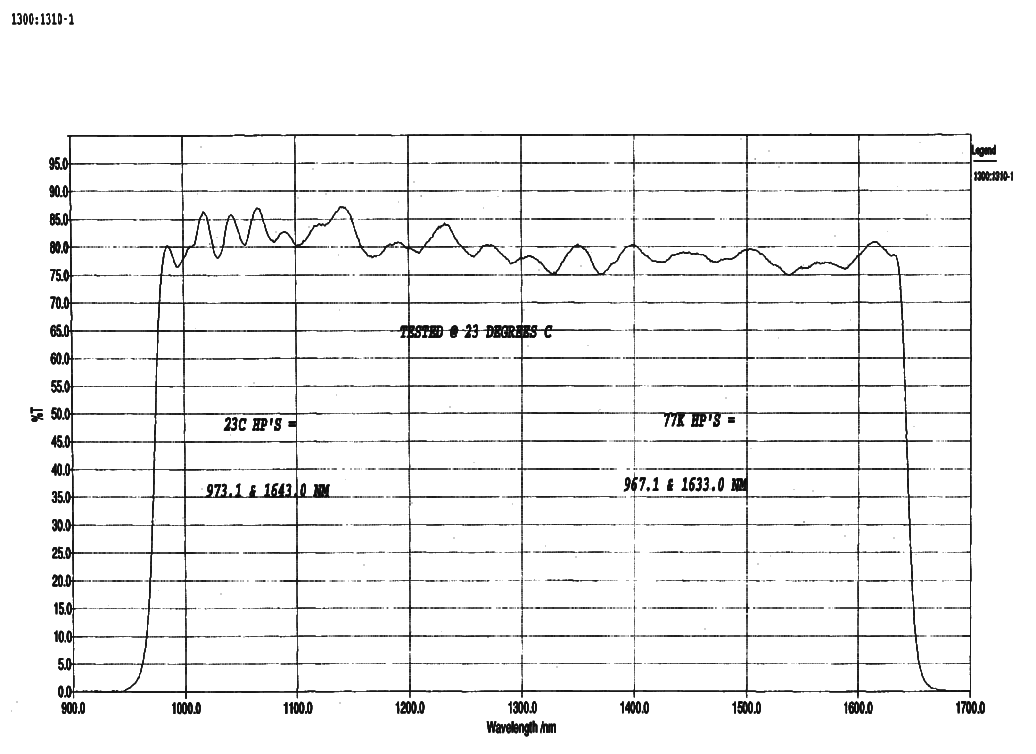
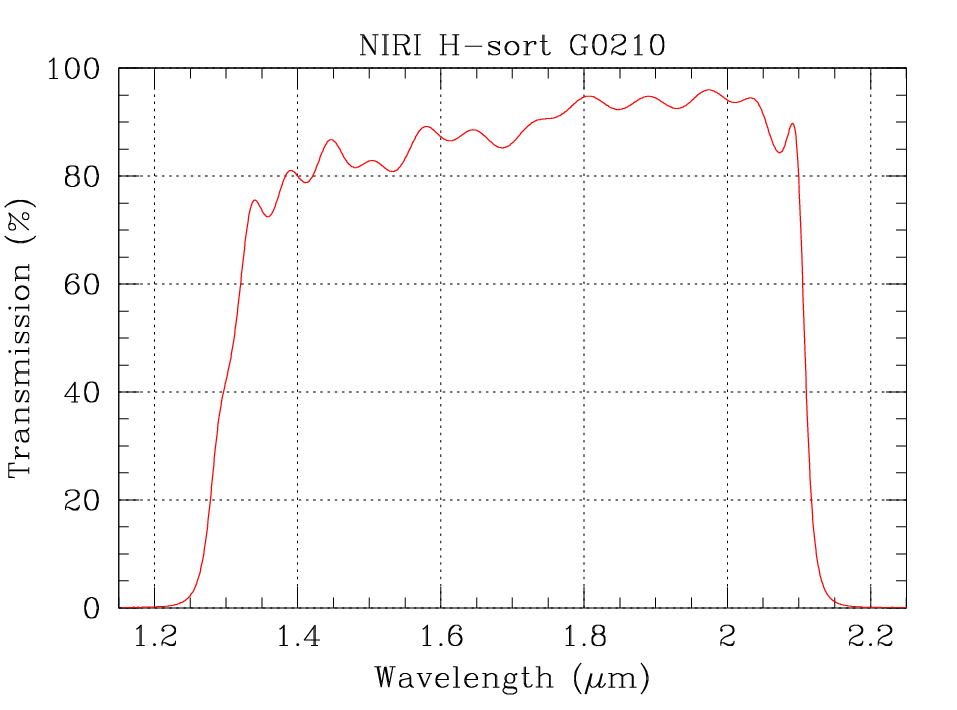
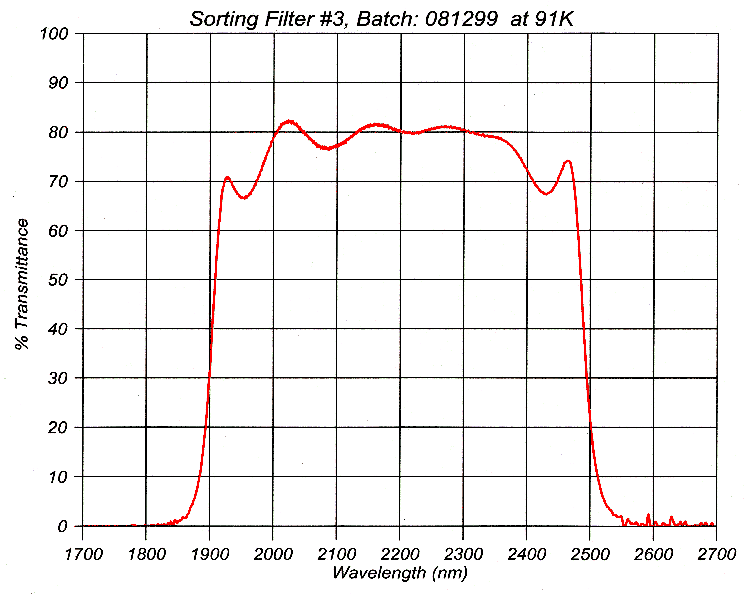
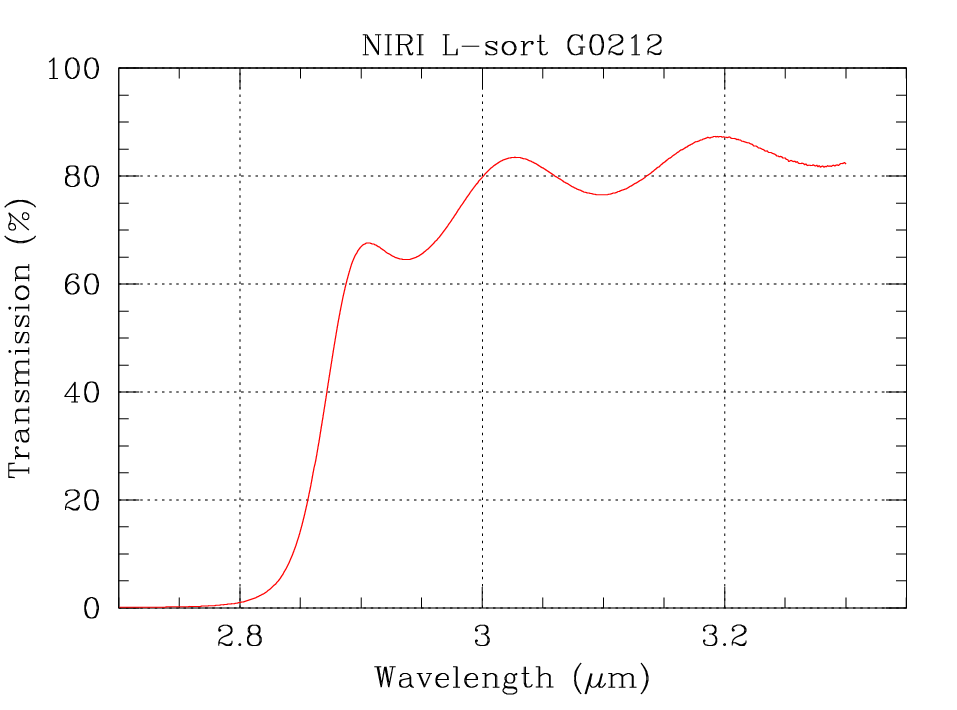
The following table gives wavelength ranges of the order-sorting filters in NIRI that are used with the grisms. The Gemini identification number for each filter is recorded in data file headers.
| Waveband | Central Wavelength (microns) | Bandpass (microns) | Gemini ID | Order-sorting filter transmission plot available | Order-sorting filter transmission data available |
| J | 1.30 | 0.97-1.63 | G0209 | yes | yes |
| H | 1.69 | 1.30-2.09 | G0210 | yes | yes |
| K | 2.20 | 1.90-2.49 | G0211 | yes | yes |
| L | 3.50 | 2.90-4.25 | G0212 | yes | yes |
| M | 5.00 | 4.40-6.00 | G0213 | yes | no |