- Governance Test
- OWG
- Safety
- Sciops
- Gemini Home
- Telescopes and Sites
- Instruments
- Observing with Gemini
- Schedules
- Data and Archive
- Access the Archive
- Acknowledgement
- Gemini Publications
- Helpdesk
- Future Instrumentation
- Statistics
- Publications
Change page style:
NIRI
Overview of NIRI's Capabilities
Gemini's Near InfraRed Imager and Spectrometer, NIRI, was built by the University of Hawaii's Institute for Astronomy. It provides a range of imaging and spectroscopy options in the 1-5 micron wavelength region.
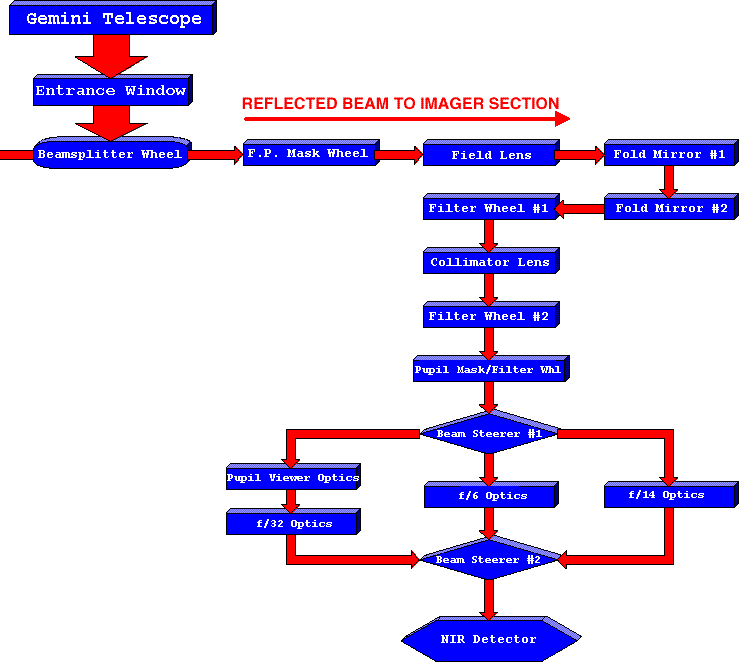
NIRI's detector is a 1024x1024 ALADDIN InSb array. The instrument has three cameras: f/32, f/14, and f/6. In imaging mode they provide plate scales of 0.022, 0.050, and 0.117 arcsec pixels, respectively and fields of view of 22x22, 51x51, and 120x120 arcseconds squared, respectively. A large number of broad- and narrow band filters are available. Imaging with all cameras and all filters is possible, with the exceptions of the L' band at f/6 and the M band at f/6 and f/14, where the background saturates the array in the minimum exposure time. At f/6 a set of KRS5 grisms, slits of varying width, and blocking filters are available to provide low-moderate-resolution spectroscopic coverage over almost the entire 1.0-5.5μm region.
The Gemini facility adaptive optics (AO) system, ALTAIR, is available for use with NIRI at f/14 or f/32, either with a natural guide star or the laser guide star, for all imaging except in the M band (the advantage of AO at L' is modest and is only for point sources). Three f/32 grisms covering 1.05-2.41μm at f/32 at moderate resolution are also available for use with ALTAIR.
The Instrument Scientist for NIRI is Andrew Stephens.
Announcements
No current announcements. See the Status and Availability pages for archived news items.
NIRI science highlights
How to use these pages
The NIRI pages are organized as follows:
- Status and Availability: Modes available in the current and upcoming semesters; links to news items
- Imaging: Components used in imaging mode and guidance on how best to use the instrument in this mode
- Spectroscopy: Components used in spectroscopy mode and guidance on how best to use the instrument in this mode
- Sensitivity and Overheads: Sensitivity tables, integration time calculator, and details of observing overheads
- Guiding Options: Guiding considerations, and wavefront sensors available for use with NIRI
- Calibration: How to calibrate NIRI observations
- Observation Preparation: How to configure NIRI in the Observing Tool
- Data Format and Reduction: Examples of NIRI data and links to data reduction resources
- Documents: NIRI design documents and references
Also see the Near-IR Resources section, which contains generic information about observing at 1-5um as well as details about calibrations, standard stars, etc. that apply to NIRI, GNIRS, NIFS, Phoenix and FLAMINGOS2.