Announcements
This page describes the suite of calibration frames routinely taken for GSAOI. Applicants are encouraged to review the information in the instrument and GeMS pages in order to understand the level of precision that can be achieved with the standard set of calibrations.
Applicants should not include time for baseline calibrations in their Phase I proposals. If additional calibrations are deemed necessary, for example to achieve a precision beyond that provided by the baseline set, then these must be included explicitly as part of the Phase I proposal and Phase II science program. Any time used between the hours of nautical sunset and sunrise to obtain baseline calibrations will not be explicitly charged to the program but will be charged to the partner country whose NTAC recommended time (i.e. it is part of the time accounting used to balance partner usage). The time will be charged in proportion to the number of programs that receive the calibration data. Any time required for additional calibrations requested by the PI will be charged to that particular program.
Baseline calibrations will be obtained for all observations, and shared between programs. GSAOI calibrations are associated to a particular science data through the Gemini Observatory Archive (GOA). Instructions on how to retrieve the science data and associated baseline calibrations required for a program are given in the GOA Help web page. Calibrations requested outside the baseline set are included with the program data.
- Baseline Calibrations
- Photometric Standards and zero points
- GSAOI Zero Points monitoring
- Download data from the Gemini Observatory Archive (GOA)
- Pre-defined queries for Flats (Dome and Twilight) and Photometric standards for each GeMS/GSAOI run
Baseline Calibrations
For all queue observations, a set of standard calibrations (the "baseline calibrations") will be taken by Gemini Staff to ensure the long-term utility of data in the archive. The baseline calibration set varies from instrument to instrument and from mode to mode. The table below describes the GSAOI baseline calibrations, as well as provides information on how and when to request additional frames.
All GSAOI baseline calibrations are taken from the GS-CALYYYYMMDD (shared) program, and not from the individual science programs. In the new Gemini Observatory Archive, the calibrations are associated automatically when you search for the science data by clicking the tab "Load Associated Calibrations". See the Gemini Observatory Archive Help page for detailed instructions on the procedures to search for data and associated calibrations.
GSAOI Baseline Calibrations
| Measurement Type | Notes |
| Bad pixel mask | Derived each semester from GCAL H band flats and dark images. The GSAOI detectors have less than optimal cosmetic quality, due to the presence of "dead" pixels, light-emitting pixels, "killed" spots and a significant number of hot pixels. All of these are found to be quite stable, but the number of hot pixels detected (for a given cut level above the mean value in the dark frame), is dependent on the exposure time of the dark frames used. The standard BPM included in the Gemini GSAOI IRAF package is defined using 150sec darks. If desired, the applicants can require to take one set of 10-15 frames (darks + flats) per semester using darks with exposure times/filter tailored to their program in order to construct a BPM. Flats can be either GCAL or domeflats. A document describing the process followed to derive the standard BPM is now available. |
| Flat field |
The baseline flat fields for GSAOI are taken as dome flats for all broad band and for those narrow band filters used during the semester. A set of 15 flats with the dome lamps ON and OFF are observed per filter per laser run. OFF flats are taken for the H and K band broad and narrow band filters.
|
| Fringe Frames | Not applicable |
| Dark / Bias |
The dark current for GSAOI is of the order of 0.01 e-/s/pixel, implying on a total dark charge of ~12e- for the longest integration time allowed (20min). This very low dark current implies that daily darks taken with the same exposure time as the science frames (for dark subtraction as part of the standard reduction process) are NOT necessary, and in fact, subtracting a dark frame from the science and sky frames prior to subtracting the sky from the science proper will result in increasing noise. Both the dark current and the cross-shaped "warm" pixels are accounted for when subtracting the sky. |
| Wavelength calibration | Not applicable |
| Telluric standard star | Not applicable |
| Flux standard stars |
Selected from the Persson et al. (1998) list. Observations of standard stars are only obtained in broadband filters J, H, K, Ks, Kp. A more limited set of standards include the Z filter. Our goal is to obtain at least 2-3 standards at different airmasses each observing night. Approximate zero points are also available, and an study of the color effects originated from the differences in QE between the four arrays is ongoing. Photometric accuracy is limited to 5-10% due to uncertainties in the atmospheric extinction over Cerro Pachon, flat-fielding and sky subtraction, and the precision in the gain determination for each of the arrays. If the user is aiming at a higher photometric precision, it is necessary to self-calibrate the images, detector by detector. |
| Atmospheric extinction | Not included as part of the baseline calibration set. |
| Point Spread Function star | Not included as part of the baseline calibration set. Applicants are reminded that the PSF in an MCAO-corrected image is dependent on the position in the field AND on the geometry of the guide star constellation (plus higher order terms such as laser power and return, relative brightness of the guide stars, etc). There is probably little or no scientific gain in attempting to derive a PSF from a separate star field. |
| World coordinate system | Automatically included for each GSAOI image. Relative accuracy is currently ~0.3arcsec on average over the field. Absolute accuracy is around 5arcsec (limited by the precision in the telescope pointing). |
| Focal plane mask image | Not applicable. |
Photometric Standards and zero points
The photometric standard stars are selected from the Photometric Standard star catalogues listed in the NIR Resources web page. The photometric standards are observed as part of Baseline Calibrations for GSAOI. The observations are taken from the GS-CAL (shared) program, and not from the individual science programs. The observations of standard stars are only obtained in the J, H, Kp, Ks and K broadband filters. A more limited set of standards include the Z filter. The observations are obtained under natural seeing conditions (
Photometric Zero Points and Sky Background
Approximate photometric zero points in the J, H and Ks broadband filters were measured from data collected during April 2012 GeMS/GSAOI commissioning run. The instrumental magnitudes in the GeMS/GSAOI system were calculated as follows:
mλ = - 2.5 log Fλ
where mλ is the instrumental magnitude and Fλ is the flux in ADU/s. The resulting values for the instrumental magnitudes were then compared with the 2MASS standard magnitudes to define the zero points. Note that airmass effects were not considered in the calculation of the zero points (the observations were assumed to be taken at a “typical” airmass). The table below contains the approximate zero points for GeMS/GSAOI system. Extinction values were taken from Nikolaev et al. (2000, AJ, 120, 3340) . The sky brightness values, converted from the average counts in the sky frames, are also listed in the table.
A comparison of the values listed in the table with the values derived from the January 2012 and February 2012 commissioning runs indicates that the photometric zero-points are reasonably stable (within 3%). More detailed information about the photometric zero-points, including information about the color terms for each detector, will be posted in this web page as commissioning progresses. In the near future, more detailed information about the GeMS/GSAOI zero points will be provided through the Instrument Performance Monitoring project web page.
| Filter | Central wavelength (µm) |
Zero point magnitude | Sky background (mag/arcsec2) |
Extinction (mag/airmass) |
| J | 1.250 | 25.48 | 15.30 | 0.092 |
| H | 1.635 | 25.77 | 13.90 | 0.031 |
| Ks | 2.150 | 25.17 | 12.40 | 0.065 |
GSAOI Photometric Zero Points
Description and Goals
Every night with GSAOI science, we take images of photometric standards in the same filters as the science for that night. The photometric zero-point is added to these tables and graphs the next morning. Photometric conditions are required, but observations can be collected during twilight.
Status
First results available. More details in iPoster, presented at AAS 233, January 2019
| Band |
Table of measurements |
Plot | Monthly Averages |
|---|---|---|---|
| All bands | -- | plot | -- |
| J | link | plot | in progress |
| H | link | plot | in progress |
| K | link | plot | in progress |
| Ks | link | plot | in progress |
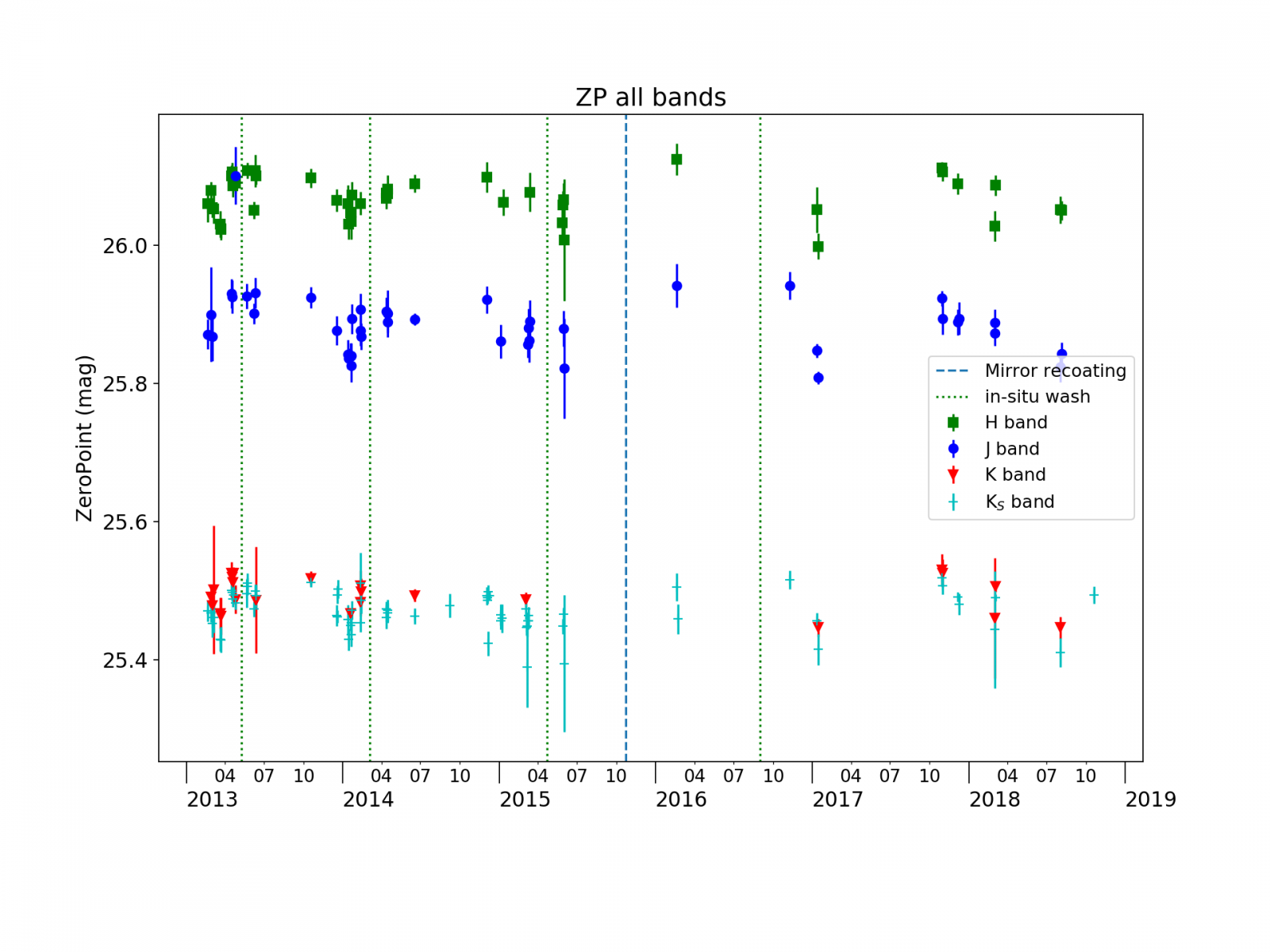

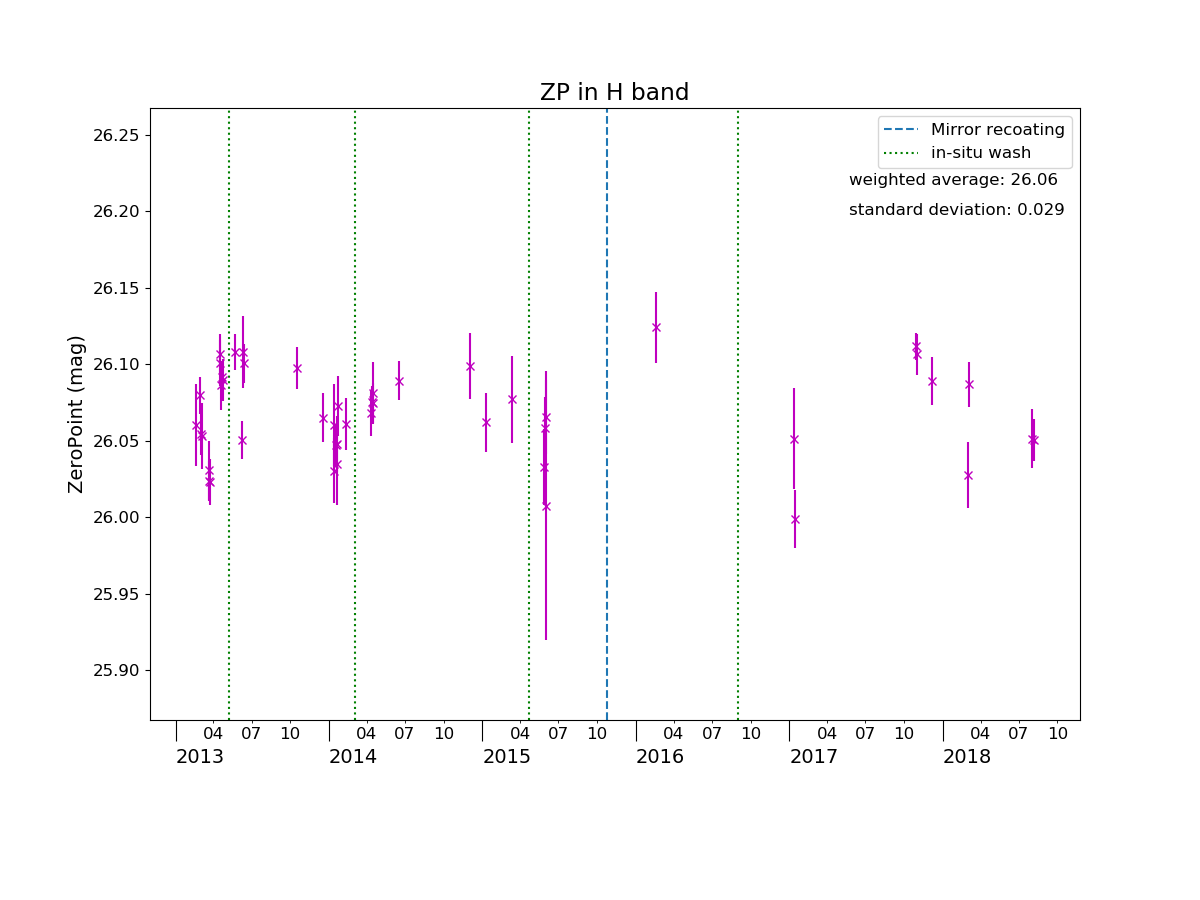
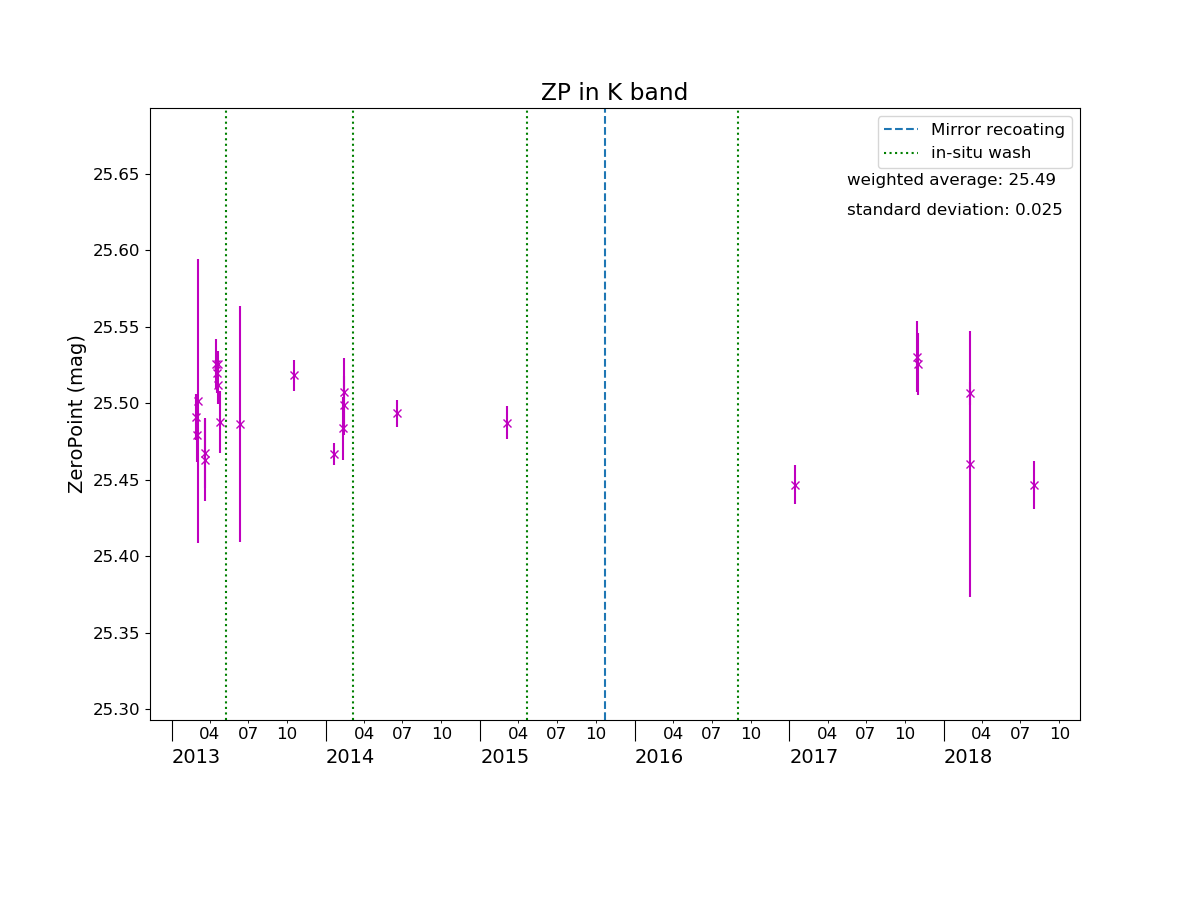
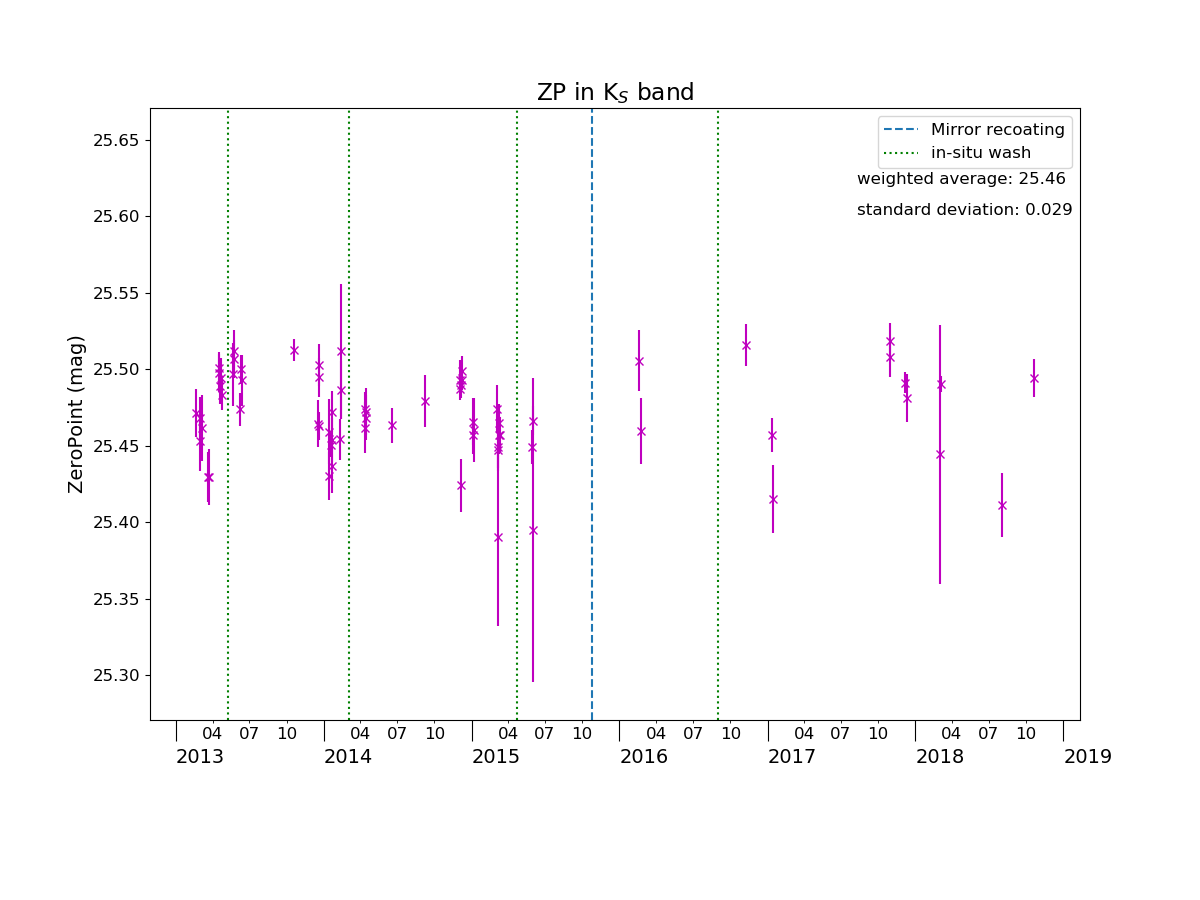
GSAOI Quick links for Calibration Searches
The links below allow for quick search and download of GSAOI calibrations since semester 2012B from the Gemini Observatory Archive (GOA). Information on how to modify or use different queries for other calibrations can be found here.
NOTE: the links in the table will open in a new window.
- 2016B Semester
- 2016A Semester
- 2015A Semester
- 2014B Semester
- 2014A Semester
- 2013B Semester
- 2013A Semester
- 2012B Semester
2016B Semester
| GeMS/GSAOI run Dates | Flats (dome and/or twilight) | Photometric Standards |
| 2017 Jan 9 - 2017 Jan 19 | Dome Flats lamps OFF | All filters |
| 2016 Nov 6 - 2016 Nov 13 | Dome Flats lamps OFF | All filters |
2016A Semester
| GeMS/GSAOI run Dates | Flats (dome and/or twilight) | Photometric Standards |
| 2016 June 12 - 2016 June 17 | Dome Flats lamps OFF | No standards observed. |
| 2016 April 13 - 2016 April 21 | Dome Flats lamps OFF | No standards observed. |
| 2016 Feb 15 - 2016 Feb 21 | Dome Flats lamps OFF | All filters |
2015A Semester
| GeMS/GSAOI run Dates | Flats (dome and/or twilight) | Photometric Standards |
| 2015 May 27 - 2015 Jun 04 | Dome Flats lamps OFF | All filters |
| 2015 Mar 04 - 2015 Mar 12 | Dome Flats lamps OFF | All filters
(includes std. for 15AC2) |
2014B Semester
| GeMS/GSAOI run Dates | Flats (dome and/or twilight) | Photometric Standards |
| 2015 Jan 03 - 2015 Jan 09 | Dome Flats lamps OFF | All filters
(include std. for 14BLP2) |
| 2014 Dec 02 - 2014 Dec 10 | Dome Flats lamps ON Dome Flats lamps OFF | All filters
(includes std. for 14BC1) |
| 2014 Aug 30 - 2014 Sep 08 | Dome Flats lamps OFF | All filters |
2014A Semester
| GeMS/GSAOI run Dates | Flats (dome and/or twilight) | Photometric Standards |
| 2014 June 09 - 2014 June 18 | Dome Flats lamps OFF | All filters |
| 2014 May 20 - 2014 May 27 | Dome Flats lamps OFF | All filters |
| 2014 April 8 - 2014 April 16 | Dome Flats lamps OFF | All filters |
| 2014 Feb 10 - 2014 Feb 18 | Dome Flats lamps OFF | All filters |
2013B Semester
| GeMS/GSAOI run Dates | Flats (dome and/or twilight) | Photometric Standards |
| 2014 Jan 12 - 2014 Jan 21 | Dome Flats lamps OFF | All filters |
| 2013 Dec 14 - 2013 Dec 21 | Dome Flats lamps OFF |
(includes std. for 13BC1) |
| 2013 Oct 13 - 2013 Oct 21 | Dome Flats lamps OFF | All filters |
|
2013 Sep 12 - 2013 Sep 16 2013 Sep 23 - 2013 Sep 27 |
No data |
2013A Semester
| GeMS/GSAOI run Dates | Flats (dome and/or twilight) | Photometric Standards |
|
2013 Jun 08 - 2013 Jun 16 |
||
|
2013 May 19 - 2013 May 24 |
||
|
2013 Apr 17 - 2013 Apr 25 |
||
|
2013 Mar 21 - 2013 Mar 25 |
||
|
2013 Feb 19 - 2013 Feb 23 and 2013 Feb 28 - 2013 Mar 05 |
2012B Semester
| GeMS/GSAOI run Dates | Flats (dome and/or twilight) | Photometric Standards |
|
2013 Jan 26 - 2013 Feb 02 |
||
|
2012 Dec 28 - 2013 Jan 02 |