Announcements
Detector Array Properties and Read Modes
The properties of the Aladdin III InSb detector array for the GNIRS science channel are given in Table 1 below. The array has nicely uniform response, only a few regions of bad and dead pixels (see table below), very low dark current and low read noise in the lowest background mode. The bias voltage may be adjusted to increase the well depth for thermal IR (L and M band) observations or for very bright targets. InSb detectors have nearly 100 percent internal quantum efficiency (QE) from 0.4 to 5 microns, with a rolloff near the cutoff wavelength of 5.5 microns. The surface of the material is highly reflective (36 percent), but this is reduced by an anti-reflection coating that gives the array an effective QE of ~90 percent over the 0.9-5 micron interval.
| Table 1: Detector Characteristics | |
| Array | Aladdin III InSb (Hughes SBRC) |
| Pixel format | 1024x1022 27-micron pixels |
| Spectral Response | <0.9 to 5.5 microns |
| Dark Current | 0.15 e-/s/pix |
| Gain | 13.5 e-/ADU |
| Well depth, 0.3V bias (near-IR) |
90,000 e- (7,000 ADU) non-linear response above 5,000 ADU |
| Well depth, 0.6V bias (thermal-IR) |
180,000 e- (14,000 ADU) non-linear response above 10,000 ADU |
| Quantum efficiency | about 90% |
| Difference in odd/even row response | 7% |
| Flat field repeatability | TBD |
| Residual image retention | Minimal impact on science; details |
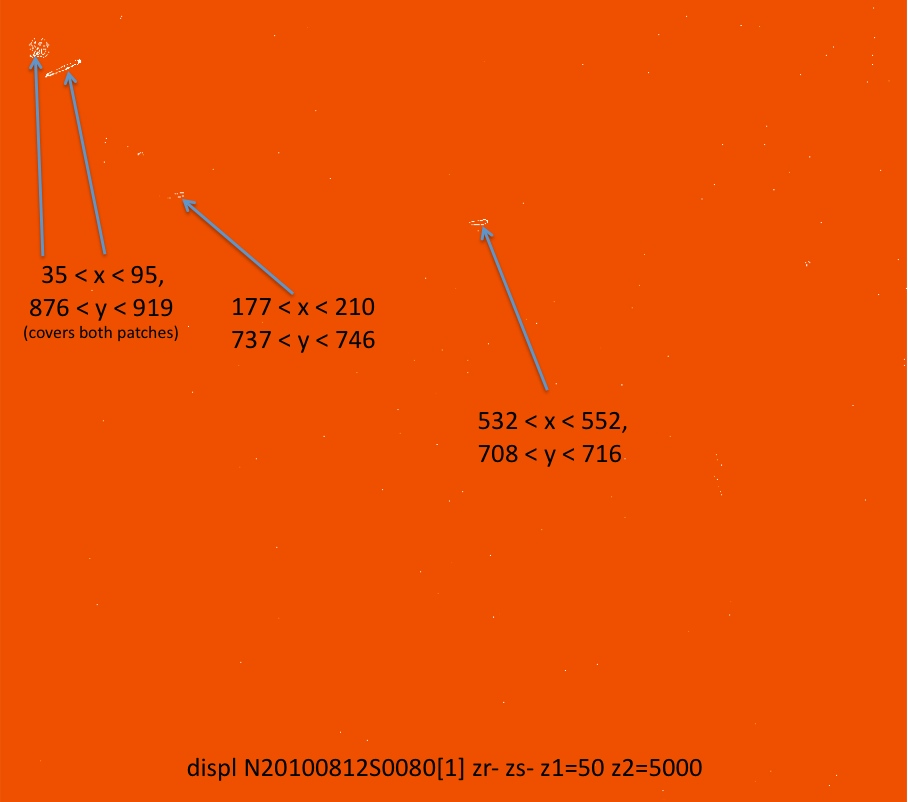
| Regions of bad pixels | (532< x <552, 708< y <716) (177< x <210, 737< y <746) (35< x <95, 876< y < 919) |
The camera turret contains four cameras in order to extend the capabilities of the instrument: Short/Long Blue/Red camera. The following table shows the main features of each camera. The "blue" cameras are optimized for the wavelength range 0.9-2.5 µm, while the "red" cameras are optimized for the wavelength range 2.9-5.5 µm. The detector is mounted at the output of the cameras, on a focus stage. The focus stage provides correction for the small focus differences between the different cameras.
| Cameras for GNIRS | |||||
|---|---|---|---|---|---|
| Pixel size | Spectral Range | Slit width | Slit Length (LS) | Slit Length (XD) | |
| Short Blue Camera | 0.15170 +/- 0.00012 "/pix | 0.9 - 2.5 µm | 0.30" - 1.0" | 99" | 7.0" |
| Short Red Cameraa | 0.15"/pix | 2.5 - 5.5 µm | 0.30" - 1.0" | 99" | 7.0" |
| Long Blue Camera | 0.05071 +/- 0.0001 "/pix | 0.9 - 2.5 µm | 0.10" - 1.0" | 49" | 5.1" or 7.0" |
| Long Red Camera | 0.05095 +/- 0.0002 "/pix | 2.5 - 5.5 µm | 0.10" - 1.0" | 49" | 5.1" or 7.0" |
aThe short red camera is not available right now. Please see the "Known Issues" page.
There is a tradeoff between the detector read noise and the time required to read out the array. The best choice depends on the brightness of the object and the background at a given wavelength (see the Observing Strategies page for more guidance). The four read modes which can be used for GNIRS observations, and the read noise and exposure times for each are given in Table 2.
| Table 2: Read Modes | ||||||
| Read Mode | Low Noise Reads |
Digital Averages |
Read Noise (e-) |
Min. exp time* (sec) |
Recommended min. exp time* (sec) |
Recommended Use |
| Very Bright Objects; high background |
1 | 1 | 155 | 0.2 | <1.0 | low res. M |
| Bright Objects medium background |
1 | 16 | 30 | 0.6 | ~2.0 | Exp ~1 - 20s and/or sqrt(sig+bkgnd)>80 e/pix |
| Faint Objects low background |
16 | 16 | 10 | 9.0 | 20.0 | Exp ~20 - 60 s and/or sqrt(sig+bkgnd) < 50 e/pix |
| Very Faint Objects very low background |
32 | 16 | 7 | 20.0 | 60.0 | Exp > 60 s and/or sqrt(sig+bkgnd) < 20 e/pix |
* The minimum exposure times are the times required to read the array. The recommended minimum exposure times allow efficient observing (spending at least 2/3 of the time actually exposing the array as opposed to reading it).
Some problems and features related to the detector and its controller are described on the "Known Issues" page.
Order-blocking, Acquisition, and Neutral Density Filters
The filters listed below may be used for photometry on the Mauna Kea system. As they vignette the outer portions of the GNIRS acquisition keyhole, they should not be used for purposes of acquisition for spectroscopy.
| Mauna Kea Photometric Filters in GNIRS | |||||
| Filter Name | Wavelength range | Transmittance plot measured in GNIRSa |
Transmittance numerical data measured in GNIRSa |
Transmittance curve from manufacturer |
Gemini ID |
| Y | 0.97-1.07µm | yes | yes | - | G0544 |
| J-MK | 1.17-1.34µm | yes | yes | - | G0545 |
| K-MK | 2.03-2.37µm | yes | yes | - | G0546 |


ascaled to transmittance of the XD filter in the relevant wavelength interval
The filters listed below are used during spectroscopy for order-blocking and (with the exceptions of M, L, and XD) for acquisition. For acquisition they provide complete and unvignetted views of the acquisition "keyhole," whose dimensions are shown here.
| Order-blocking Filters for Spectroscopy and Acquisition | ||||||
| Filter Name | Diffraction order |
Wavelength range | Transmittance plot measured in GNIRSa |
Transmittance numerical data measured in GNIRSa |
Transmittance curve from manufacturer |
Gemini ID |
| Mb | 1 | 4.4 - 6.0um | - | - | yes | G0501 |
| Lb | 2 | 2.8 - 4.2um | - | - | yes | G0502 |
| K | 3 | 1.91 - 2.49um | yes | yes | yes | G0503 |
| H | 4 | 1.47 - 1.80um | yes | yes | yes | G0504 |
| J | 5 | 1.17 - 1.37um | yes | yes | yes | G0505 |
| X | 6 | 1.03 - 1.17um | yes | yes | yes | G0506 |
| XDb | 3-8 (cross-disp) | 0.9 - 3.56um | - | - | yes | ED316 |


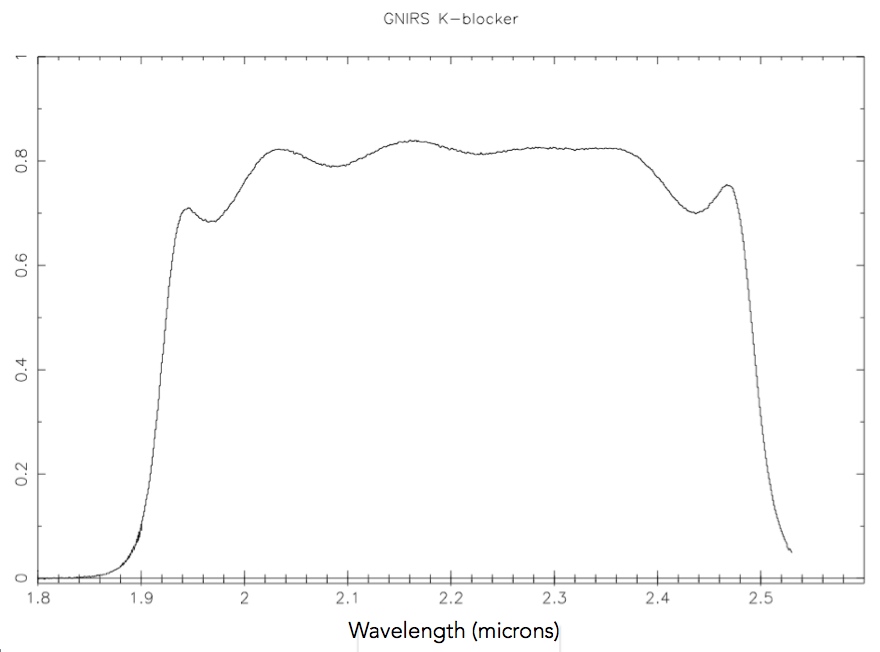
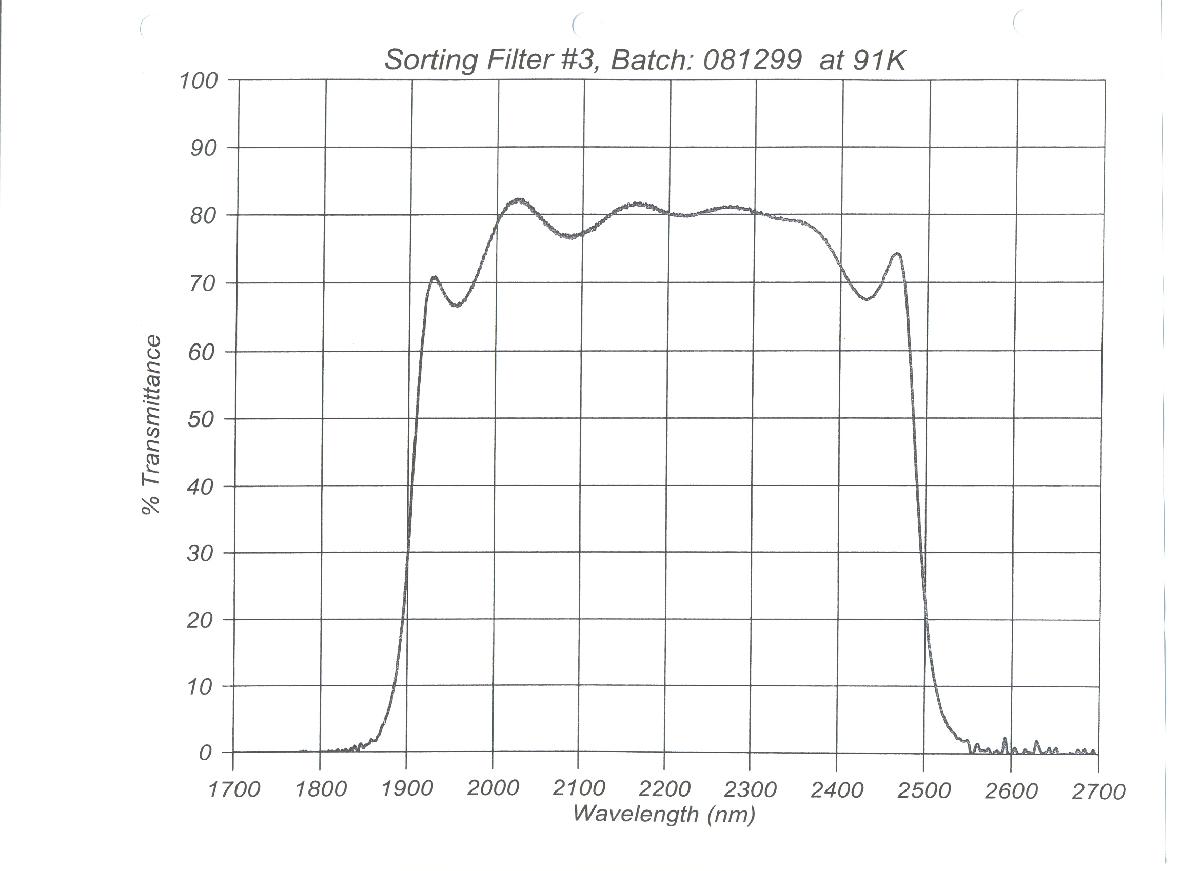

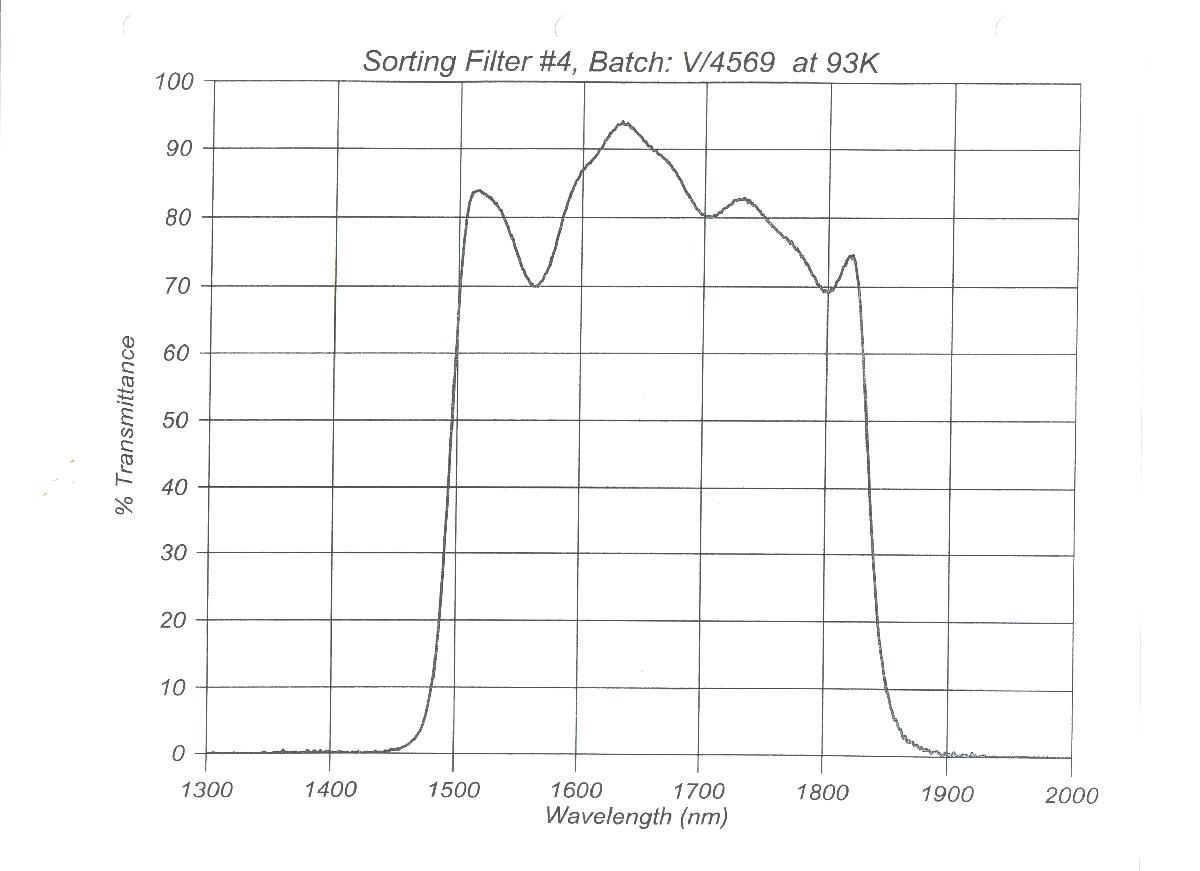
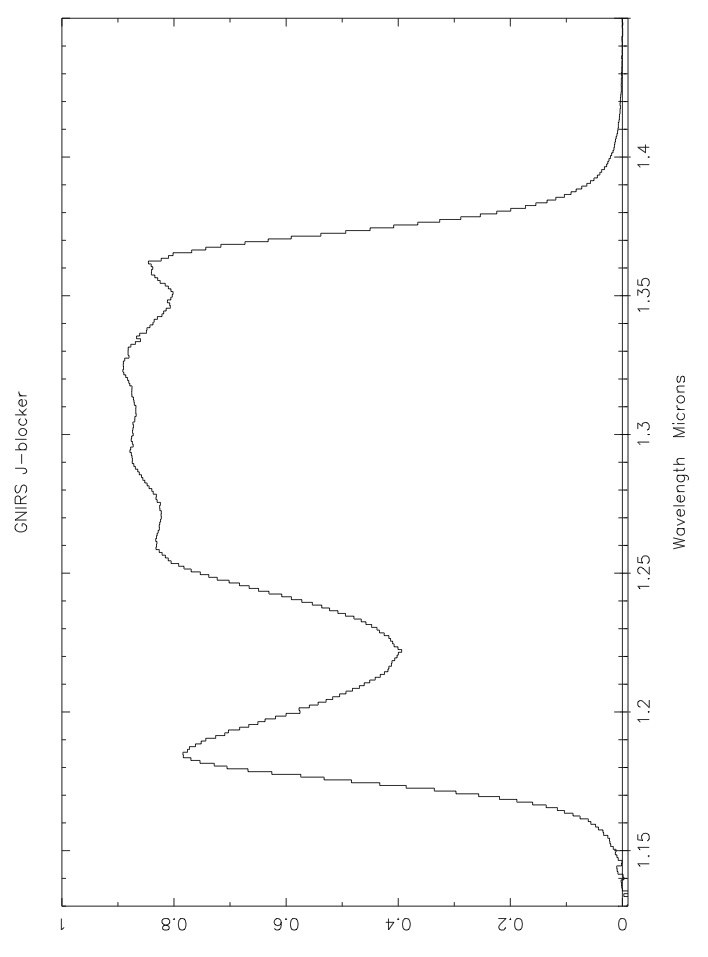

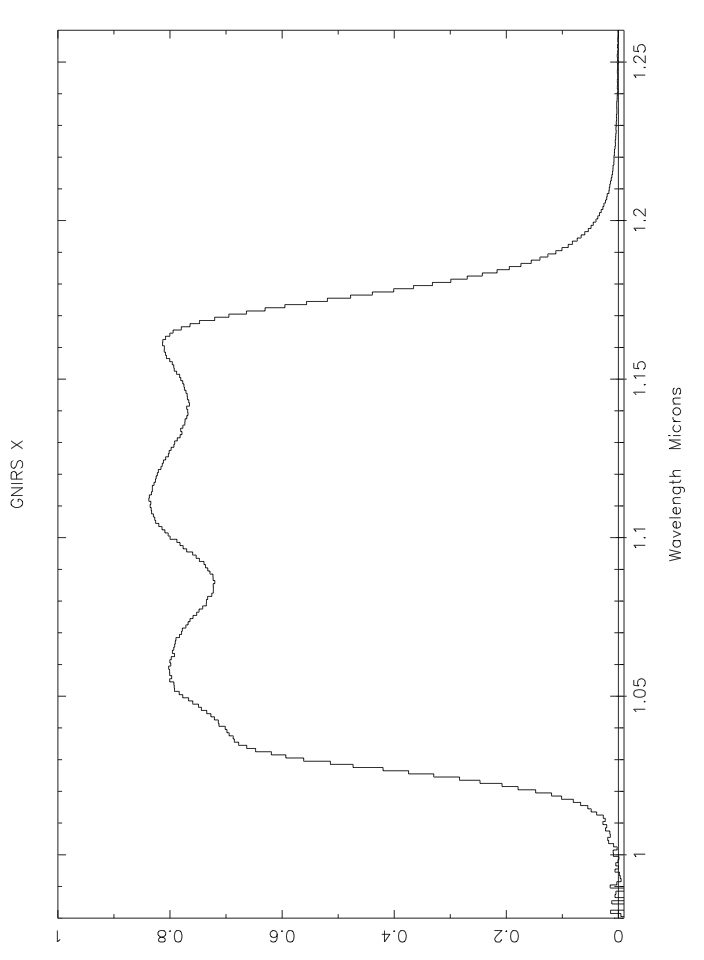
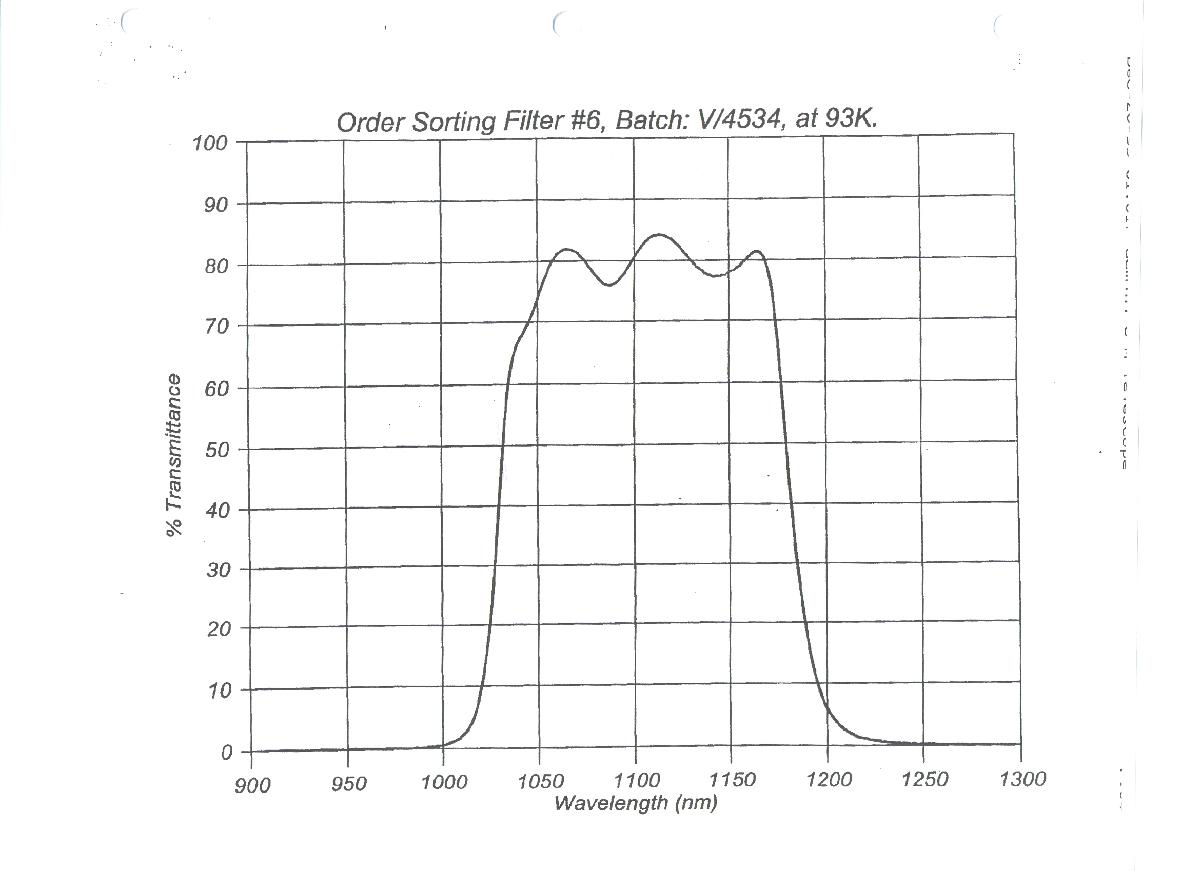
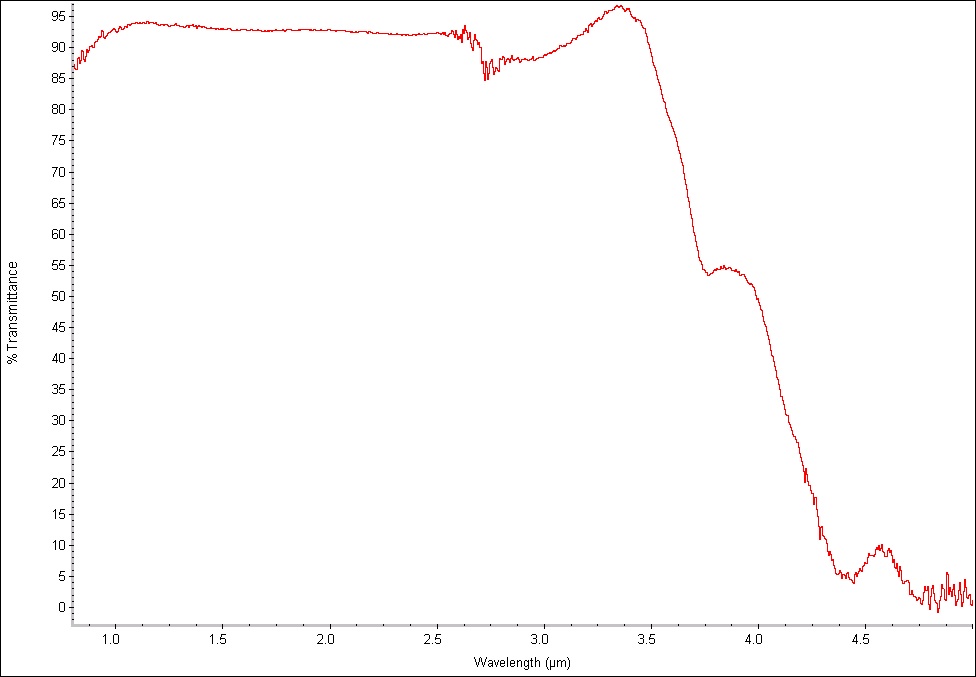
ascaled to transmittance of the XD filter in the relevant wavelength interval
bNot used for acquisition
| Acquisition Filters (narrow band) | ||||||
| Filter Name | Width | Central Wavelength | Transmittance plot measured in GNIRS |
Transmittance data measured in GNIRS |
Transmittance plot from manufacturer |
Gemini ID |
| H2 | 1.5% | 2.122um | yesa | yesa | - | G0521 |
| PAH | 1.5% | 3.295um | yesb | yesb | - | G0523 |

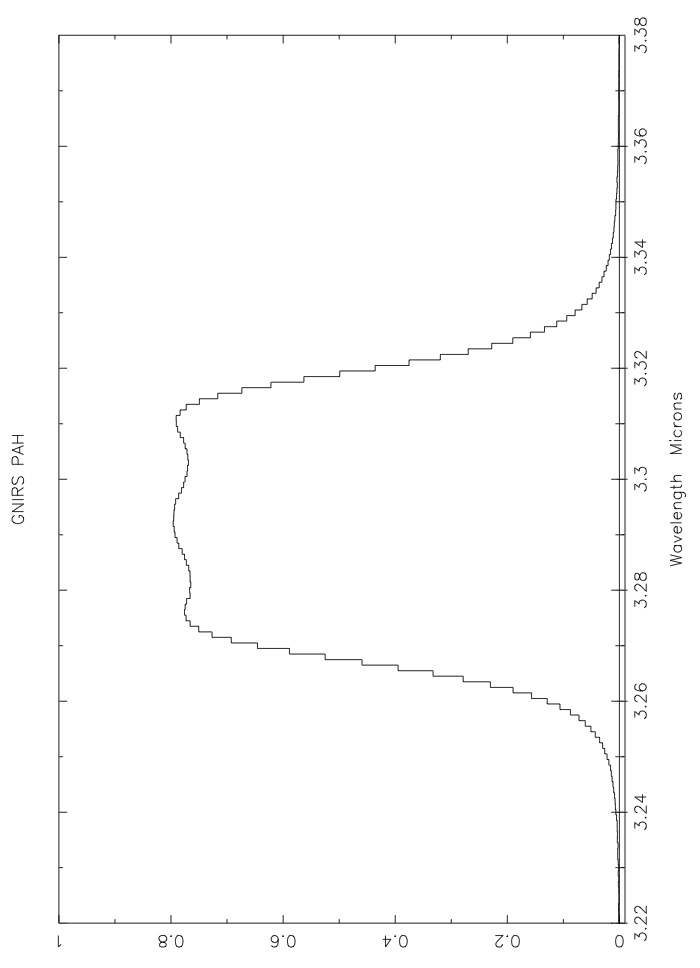
ascaled to transmittance of the XD filter in the relevant wavelength interval
bscaled to transmittance of the L filter in the relevant wavelength interval
Acquisition filters are defined in acquisition observation sequences - see the OT Details and Acquisition pages for more information.
A neutral density filter used for acquisition of very bright objects is also available for use (currently with the H and H2 filters only). Its properties are summarized below. Because the ND filter offsets images by ~0.1 arcsec perpendicular to the slit, It should not be used if the slit width is 0.45 arcsec or less, unless the neutral density is also used for spectroscopy.
| Attenuation by Neutral Density Filter | |||||
| 1.1µm | 1.25µm | 1.65µm | 2.2µm | 3.5µm | 4.8µm |
| 350X | 250X | 170X | 130X | 100X | 85X |
Slit Properties
The spectrograph entrance slit is defined by two mechanisms. The width of the slit is defined by the one of several slits in a photo-etched mask located in the slit slide; the length of the slit is defined by one of several openings in the decker slide.
The slit mask is located at the re-imaged focal plane, while the decker apertures are slightly ahead of it, and therefore somewhat out of focus (by a few pixels). The decker sizes are matched to the full width of the array in long slit mode, or to the minimum spacing between adjacent spectra when the cross-dispersing prisms are used.
The slit widths currently available are listed below:
| Slit name | Slit width (pixels) [nominal values] |
|
| short camera (0.15"/pix) | long camera (0.05"/pix) | |
| 0.10 arcsec | n/a | 2 |
| 0.15 arcsec | n/a | 3 |
| 0.20 arcsec | n/a | 4 |
| 0.30 arcsec | 2 | 6 |
| 0.45 arcsec | 3 | 9 |
| 0.675 arcsec | 4.5 | 13.5 |
| 1.0 arcsec | 6.7 | 20 |
The slit (decker) lengths in the long slit and crossed-dispersed modes are:
| Configuration | Slit length | |
| short camera | long camera | |
| Long-slit | 99 arcsec | 49 arcsec |
| Cross-dispersion | 7.0 arcseca | 5.1 arcseca or 7.0 arcsecb |
a 0.9 - 2.5 µm; see the prisms and XD page
b 1.2 - 2.5 µm; see the prisms and XD page
Slit throughputs for several different slit widths are presented in the following table as a function of image quality. Note that these throughputs are for an S/N-optimized software aperture (i.e. integrated along the slit) of 1.4 times the image FWHM and are not based on the total signal within the slit. The shape of the model PSF does not vary significantly across the 1-5um range and so this table is independent of wavelength. (Of course the delivered image quality does vary with wavelength and is described as part of the observing condition constraints). The values in this table were calculated with the GNIRS Integration Time Calculator.
| Slit width (arcsec) |
Image quality (50% EED in arcsec) | ||||||
| 0.33 | 0.39 | 0.50 | 0.61 | 0.81 | 0.89 | 1.56 | |
| 0.10 | 0.23 | 0.19 | 0.15 | 0.12 | 0.09 | 0.08 | 0.04 |
| 0.15 | 0.34 | 0.30 | 0.24 | 0.19 | 0.14 | 0.13 | 0.07 |
| 0.20 | 0.45 | 0.40 | 0.32 | 0.26 | 0.19 | 0.17 | 0.09 |
| 0.30 | 0.62 | 0.56 | 0.46 | 0.38 | 0.29 | 0.27 | 0.14 |
| 0.45 | 0.78 | 0.72 | 0.63 | 0.54 | 0.42 | 0.39 | 0.23 |
| 0.675 | 0.82 | 0.81 | 0.73 | 0.66 | 0.54 | 0.50 | 0.31 |
| 1.0 | 0.90 | 0.87 | 0.83 | 0.81 | 0.74 | 0.71 | 0.49 |
Slit orientation: With GNIRS mounted on a side port of Gemini North and for a slit position angle of 90 degrees, further east corresponds to lower column numbers. For a slit position angle of 0 further north corresponds to lower column numbers.
LR-IFU and HR-IFU Properties
The GNIRS Low and High Resolution IFUs are image slicers installed permanently in the GNIRS slit slide and they are therefore always available during GNIRS observing. They are inserted into the beam like a normal long slit, with light entering through a rectangular aperture at the front and leaving through a slit at the rear. The internal optics are gold-coated reflective surfaces and are carefully baffled to prevent stray or scattered light from entering the spectrograph.
The LR-IFU reformats the incident telescope image into 21 slices of width 0.15", while the HR-IFU into 25 slices of width 0.05". The IFUs introduce an anamorphic magnification such that each slice projects onto 2 pixels in the dispersion direction (like the 0.3" long slit for the LR-IFU and the 0.1" long slit for the HR-IFU); this provides critical sampling of the spectral resolution element whilst still allowing the spatial pixels to be square. At the detector, the image slices are divided along their length by the detector array to form the 0.15" square LR-IFU elements and the 0.05" square HR-IFU elements. Gaps of a few pixels between adjacent slices allow the boundaries to be identified easily.
Because of the anamorphic magnification, the spectral resolution and spectral coverage of the IFUs resemble those of the 2 pixels slit described in this table, while the optical efficiency is roughly 70-90% of the 1 pixel long slit one (due to the additional IFU optics).
| General Characteristics | LR-IFU | HR-IFU |
|---|---|---|
| Field of View | 3.15"x4.80" (15.1 arcsec2) | 1.25"x1.80" (2.25 arcsec2) |
| Spatial Sampling | 0.15"x0.15" | 0.05"x0.05" |
| Number of Slices | 21 | 25 |
| Pixels per Slice | 32 | 36 |
| Number of Spatial Elements | 672 | 900 |
| Spectrum Length | 1024 pixels | 1024 pixels |
| Total Slit Length inc. gaps | 798 Short Camera pixels | 996 Long Camera pixels |
| GNIRS Camera Employed | Short Camera | Long Camera |
Gratings
The GNIRS grating turret contains three gratings (10, 32 and 110 l/mm), each with an effective first order blaze wavelength of 6.6 µm. The wavelength diffracted with peak efficiencies then correspond fairly well to the atmospheric windows centered at 5, 3.5, 2.2, 1.65, and 1.25 µm (M, L, K, H, J) for orders 1 through 5 respectively. The blocking filters used for these orders cover most or all of the free spectral ranges of the individual orders. A filter for order 6 (1.1 µm, called X) is also available.
The following brief table shows average values of the resolving power for the short and the long cameras. Refer to this more detailed table for more precise information on wavelength coverages, resolving powers, and blocking filter ranges.
| Resolving power (2 pix slit width)(a) | ||
|---|---|---|
| Grating (l/mm) | Short Camera | Long Camera |
| 10.4 | (b) | ~1700 |
| 31.7 | ~1700 | ~5100 |
| 110.5 | ~5900 | ~17800 |
Notes:
(a) Resolving power depends on 1/(slit width) for sources that fill the slit width; for example, the values of R for a 3 pixel-wide slit are 2/3 the values in the table.
(b) This mode potentially provides R=570 but offers no advantage over R=1700 and is not used in practice.
Prisms and XD Spectroscopy
GNIRS contains two prisms designed to enable cross-dispersed spectroscopy in the 0.9-2.5 µm region. One, known as SXD, was designed for use with the short blue camera (0.15"/pix), and the other, known as LXD, for use with the long blue camera (0.05"/pix). The prisms disperse incident light in the direction orthogonal to that of the gratings, which allow grating orders 3-8 to appear at different locations on the array, as shown here. The prisms are made of SF57 glass and have excellent transmission across almost the whole wavelength range but attenuate slightly at the long wavelength end of the K-window.
Because the prisms spread the orders along the slit direction, it is necessary to use a much shorter slit than can be used in the single order / long slit mode. The slit in use with the prism for the short blue camera prism has a length of 7.0 arcsec; that for the long blue camera has a length of 5.0 arcsec. The long blue camera can also be used with the SXD prism, and the 7.0" slits, but then can only cover orders 3-5 (J, H, and K - but may miss the very shortest part of the J band). If the science does not require the shorter wavelength orders, the user can make use of this configuration which gives increased spatial coverage and greater flexibility (e.g. in nodding along the slit), with only a small degradation in spectral resolution.
Atmospheric refraction, which causes a wavelength dependent smearing of the light from the target along the elevation angle (sometimes called the parallactic angle), is always an issue at zenith angles greater than 45 degrees for the long camera and can be an issue for the short camera, particularly when the narrowest slits are used. The effect of differential refraction is shown in this table. Note that roughly 2/3 of the differential refraction in the 1.0-2.5 µm region occurs between 1.0 µm and 1.5 µm, and that the effects of flexure between the guider and GNIRS also need to be considered when selecting the position angle of the slit.
The prisms degrade the spectral resolution when used with the long blue camera at the highest spectral resolutions (i.e., with the narrowest slit - 0.10 arcsec). The degradation has been measured to be 15% with the LXD prism and 25% with the SXD prism. With wider slits the degradation is much less.
The following table summarizes the properties of each cross-dispersed mode described above.
| GNIRS in XD Mode | ||||
| Configuration camera+prism |
Slit Length (arcsec) |
orders observed | wavelength coverage |
spectral resolution with 2-pix wide slit |
| SB (0.15") + SXD | 7.0 | 3-8 | 0.9-2.5µm | 2.0 pix |
| LB(0.05") + LXD | 5.0 | 3-8 | 0.9-2.5µm | 2.3 pix |
| LB(0.05") + SXD | 7.0 | 3-5 | 1.2-2.5µm | 2.5 pix |