Announcements
Summary
- GeMS performance is very uniform over a 85x85arcsec square field, both in terms of Strehl ratios and more general PSF characteristics.
- Images are close to be diffraction-limited, in terms of FWHM, over the full field of view.
- Strehl ratio under median seeing conditions varies from 15% to 50% in the 1-2.5 micron range and 0-30 degrees zenith angle, with relative uniformity (relative Strehl ratio standard deviation) from 1 to 5%.
- Three natural guide stars are needed to get the best compensation from GeMS. Based on current limitation in magnitude limits (R=16) we estimate a sky coverage of ~55% for all the portion of the sky reachable from Gemini South, i.e. dec < +20, even when sky background noise and windshake jitter are taken into account.
- The overall performance is a weak function of the exact match between the deformable mirror conjugation altitude and the location of the turbulent layers.
- Under median seeing conditions, GeMS brings a 1.5 to 1.7 magnitude sensitivity gain over the 1-2.5 micron range on point sources with respect to seeing limited imaging. Gains with respect to HST/NICMOS, in the same conditions, are 0.3 (J) and 1.2 (K) magnitudes.
- Multiplex gains with respect to Classical AO systems (like Altair) are factors of 10 to 20 in corrected sky area.
The information below concerns the performance of GeMS in terms of delivered image quality (FWHM) and delivered Strehl. Also provided is information about the NGS Wave Front Sensors limiting magnitudes, sky coverage, PSF uniformity and limitations to observe with GeMS due to the natural seeing and weather conditions, and the elevation of the science targets. The sensitivity, photometric zero points and throughput obtained with GeMS and GSAOI can be found in the GSAOI web page.
Delivered image quality (FWHM) and Strehl ratios
The GeMS Strehl ratios and FWHM performance presented in this section are based on data collected between December 2012 and June 2013 (33 nights). The delivered Strehl ratios and FWHM measured under different seeing conditions are shown in Table 1 and Table 2 respectively. The results are based on images observed with a constellation of 3 NGS and with exposure times between 10 and 180 seconds. Lower performance can be expected if the observations use less than three NGS. The GeMS performance using less than 3 NGS can be evaluated and visualized using the OT. Instructions are described here.
The delivered FWHM and Strehl ratios not only depend on the selected NGS constellation, the number of NGSs and their brightnesses, but also depend on the laser guide star (LGS) photons return (this parameter varies seasonally), turbulence profiling (Cn2(h)), non-common path aberrations and other AO optimization and calibration parameters. For a given Gemini IQ constraint, the values presented in the tables may vary significantly if, for example, the LGS photons return is too low or turbulence profiling is too high.
Therefore, applicants to GeMS/GSAOI observing time have to think in the terms of delivered image quality rather than in terms of Gemini IQ constraints before a proposal is submitted. For example, if your science requires a delivered FWHM ~0.15" in K-band, then your science target can be observed under less-than optimal seeing conditions, which translate to 85%-ile Gemini IQ constraint. This information must be added to the proposal.
Table 1. Delivered average Strehl ratios for different seeing conditions (seeing @ 550nm)
| Natural Seeing @550nm | Strehl ratio (J) | Strehl ratio (H) | Strehl ratio (K) | Gemini IQ constrain (zenith) |
| <0.45" | 10% | 15% | 30% | 20%-ile |
| 0.45" - 0.80" | 5% | 10% | 15% | 70%-ile |
| 0.80" - 1.00" | 2% | 5% | 10% | 85%-ile |
Table 2. Delivered FWHM for different seeing conditions (seeing @ 550nm)
| Natural Seeing @550nm | FWHM (J) | FWHM (H) | FWHM (K) | Gemini IQ constrain (zenith) |
| <0.45" | 0.08" | 0.07" | 0.06" | 20%-ile |
| 0.45" - 0.80" | 0.13" | 0.10" | 0.09" | 70%-ile |
| 0.80" - 1.00" | 0.15" | 0.13" | 0.12" | 85%-ile |
For natural seeing conditions worse than 1.0" and better than 1.2", GeMS performance is slightly worse. The delivered average FWHM is ~0.3" in J, ~0.25" in H and ~0.2" in K band. The delivered average Strehl ratios are <1% in J, < 4% in H and < 5% in K.
Strehl ratio in the OT and the GSAOI ITC: The average Strehl, Strehl error and the minimum and maximum Strehl values delivered by the Observing Tool (using the Mascot algorithm) and visualized in the OT Position Editor, are estimated taking into account the Image Quality Conditions (Gemini IQ constrains 20%-ile, 70%-ile and 85%-ile). For each filter and Image Quality condition, the GSAOI OT Position Editor also provides information about the expected FWHM. Both parameters, the average Strehl and expected FWHM, are based on the values listed in Table 1 and Table 2. To estimate the required exposure time and S/N using the GSAOI ITC, the users can either use the Strehl ratio values delivered by the OT or the values listed in Table 1.
NGS limiting magnitude
The magnitude limit of the three Canopus probes have been measured. Current limits are given in the table below:
Table 3. Natural Guide Star limiting magnitude
| CWFS limiting magnitudes | |
| Bright limit | Faint limit |
| R=8.0 mag (Vega) | R=15.5 mag (Vega) |
Note that these are not the final expected limits. Due to design errors and alignment issues, the original setup suffers from more than a 2 magnitude sensitivity loss. A new NGSWFS module is currently under design and construction, and final magnitudes should reach R~17.5. We expect this new module to be installed and tested during 2017. More details on this work can be found here
Sky coverage
We have estimated the sky coverage achievable by GeMS by running random pointings on the portion of the sky reachable at Gemini South. Assuming a limiting magnitude of R=17.5 (which should be the case after the NGSWFS upgrade), we find that about 56% of the pointing have 3 GS or more. Only 13% have no guide star at all. The map below shows how the fields are distributed in the sky. Black dots are fields with 3NGS, Green=no star, blue=1 NGS, red=2 NGS.
|
|
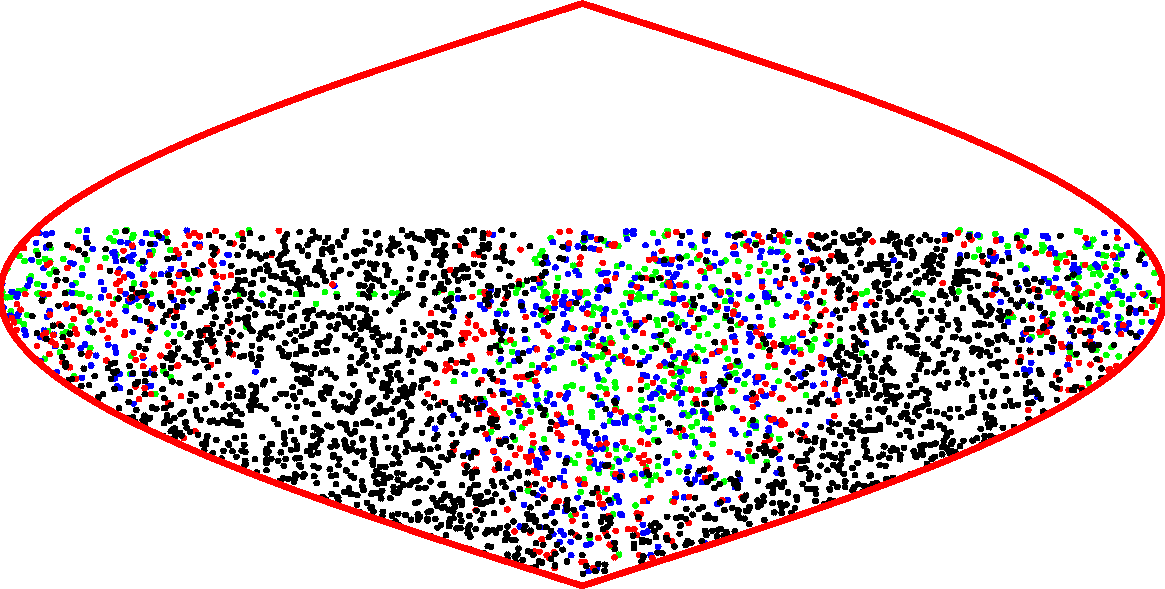
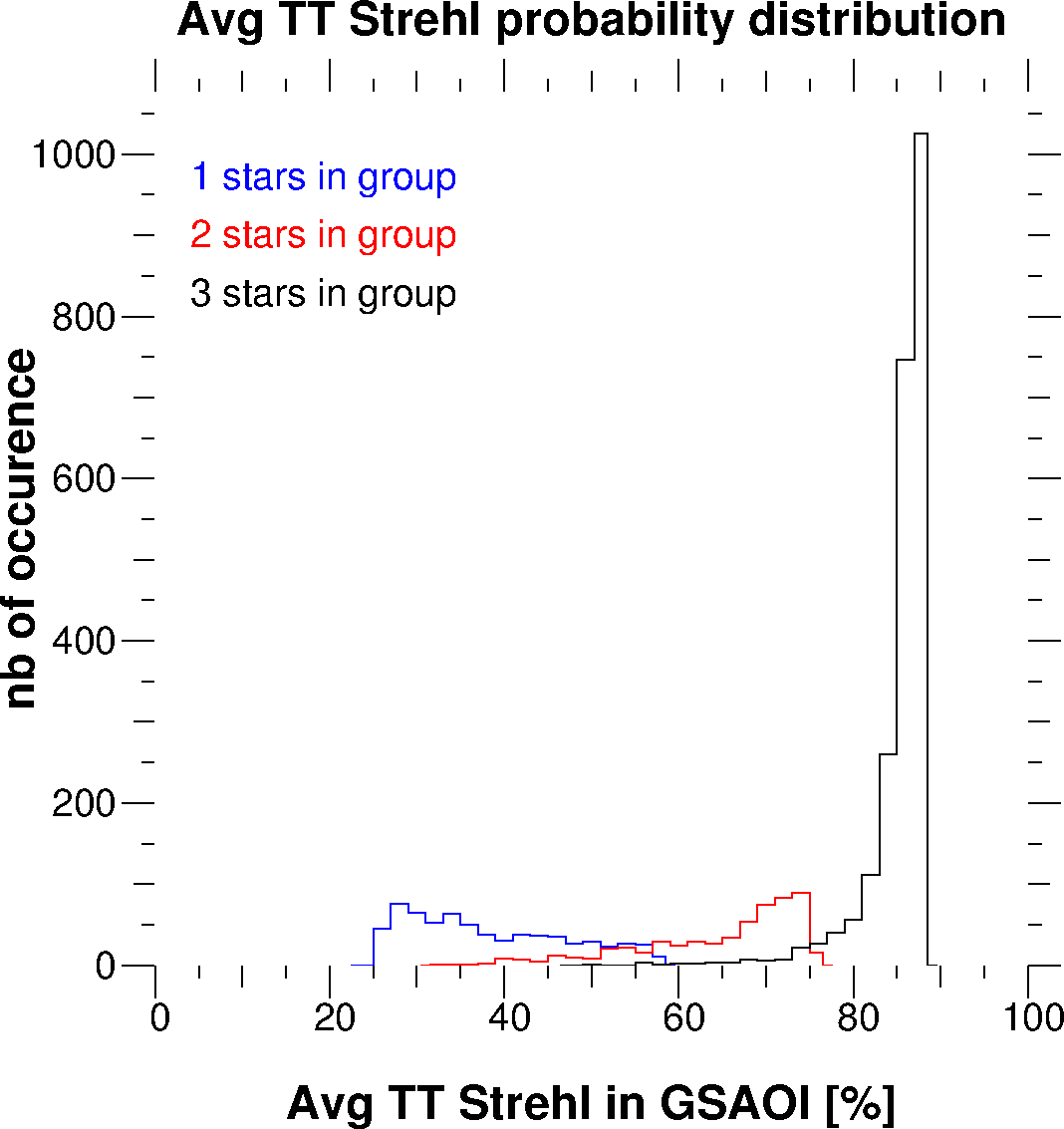
The sky distribution plot demonstrates what could readily be expected: The highest probability to find 3TTGS is in the galactic plane, and actually extend quite far out of it. Out, closer to the galactic poles, we have an about equal mix, with no obvious spatial signature, of pointings with 0 (green), 1 (blue) and 2 (red) TTGS. Below, we have looked at the SR distribution histogram for all these fields:
 |
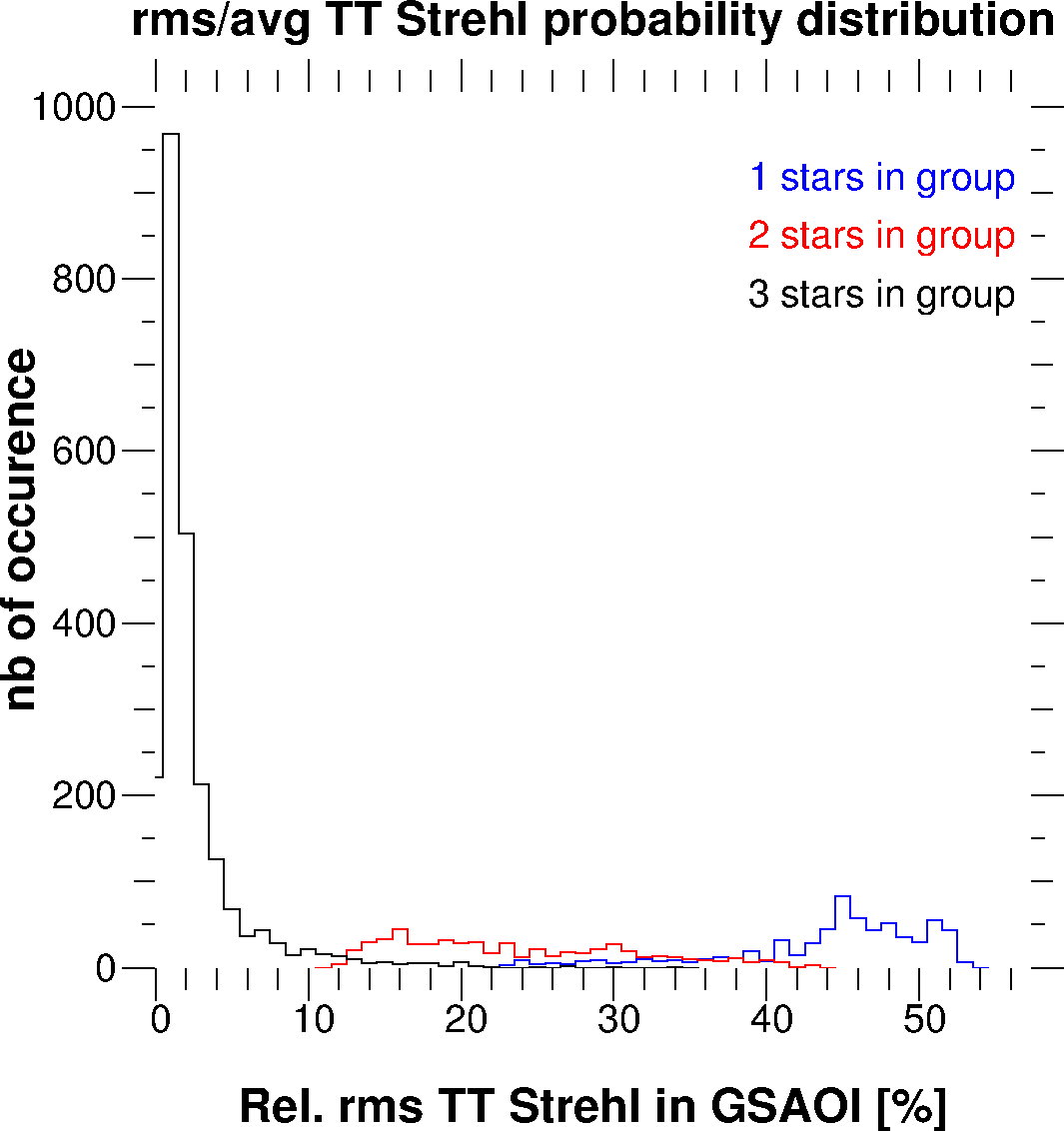 |
In general, when 3 GS are available, the Strehl is good. The peak in the average Strehl probability distribution around 85% is solely due to 3GS groups, quite uniform. The peak around 1% in the relative rms Strehl probability distribution plot is solely due to 3 GS groups.
Note that the SR reported here only accounts for the contribution of Tip-Tilt and Plate scale mode, and does not include any high-order effect. That's why values are higher than actually measured on the images. These numbers have to be treated as scaling factor that will apply to the laser corrected images.
PSF uniformity over the field
This feature is, as such, unique to MCAO. Uniform PSF vastly improve the accuracy of the image analysis. More generally, it is the experience AO users that data reduction is a critical problem, because of (1) the lack of proper and simultaneous PSF calibration and (2) PSF spatial variability in the field. For some programs (e.g. stellar population, sparse to moderately crowded field) a PSF can be found in the field itself, by definition, however small the field is. For the majority of the wide field programs (high Z clusters, galaxy morphology/evolution, YSOs, solar system, ISM), this is not the case. Having a large, uniform field goes a long way toward solving this problem: if a star is present in the field of view, it can be used for the whole 85''x85'' uniform field.
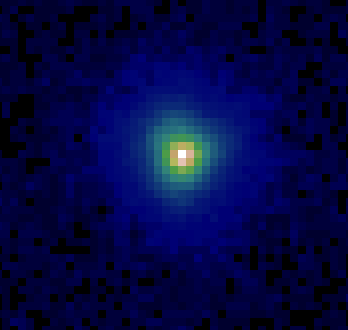
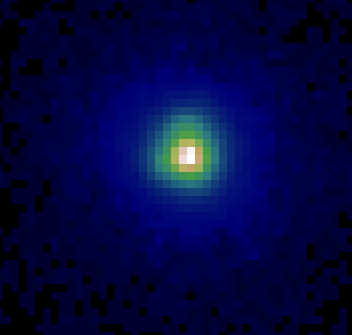
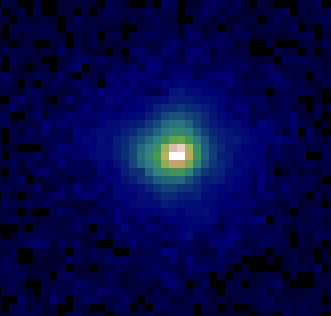
Since, by definition there are three m < 19 stars to serve as tip-tilt guide stars in a 2 arcmin diameter field, the probability of having at least one in the central 1 square arcmin field is high (60%). The PSFs are made by a nearly diffraction peak and a halo. The halo is due to the turbulence that is not conjugated to the deformable mirror, and the ratio peak / halo then depends on the atmospheric conditions. We also observe a residual static shape on the PSFs that is probably due to mis-calibration of the centroid gains. Below we show some examples of PSFs that have been extracted at different location over the 85x85 GSAOI field of view.
 |
 |
 |
Elevation, weather and seeing limitations
Limitation in elevation. While the telescope elevation hard-limit is 17 degrees, the limitation for propagating the laser is 40 degrees in elevation. This limitation is imposed by the LGSWFS zoom mechanism, which cannot mechanically keep the LGS in focus at lower elevations. In addition, the LGS return fl ux decreases signi cantly at high airmass which also affects the performance.
Safety concerns with clouds. Because of safety concerns, the laser cannot be propagated in clouds that could hide any nearby aircraft from our laser spotters. The laser can be propagated in thin cirrus, however the cirrus will reduce the laser brightness and affect the AO performance. Therefore, the cloud cover conditions condition constraints for GeMS are limited to CC=50%-ile.
High winds. High winds entering into the dome will create wind shake and could make the Tip-Tilt loop unstable. We found that the TT loop could survive with wind on the secondary of up to 2.5 - 3.0m/s.
Transiting objects. Objects that transit near to zenith also impose a limitation. Since the telescope is on an alt-azimuth mount, the instruments, mounted at Cassegrain focus, must rotate to maintain the image orientation. This effect is especially pronounced as an object transits through zenith. As Canopus is also mounted at the Cassegrain focus, it is rotating too. However because the LGSs are launched from a fixed mirror on the back of the secondary mirror, they will be seen as rotating on sky (while the natural image remains fixed). Thus the laser constellation must also follow and de-rotate to keep the LGS spots fi xed on the LGSWFS. The speed at which the laser can rotate is limited by the safe rotational speed of a mirror inside the BTO. We found that for an object transiting at an elevation of 80 degrees the laser loop would hold up to +/-2 minutes of the transit.
Poor seeing. Finally, for seeing worse than 1.5", the MCAO loops begin to lose their stability.
How to find the best NGS Asterism
GeMS needs natural guide stars to compensate for Tip-Tilt and Plate Scale modes. They can also be used to compensate for the differential flexure between Canopus and GSAOI and to compensate for the slow variation of the sodium layer altitude.
At the beginning of the GeMS+GSAOI operation, *only one guiding mode* will be available: 3 CANOPUS TTGS (CWFS). Other combinations are being tested and exercised. Complementary information can be found here.
Performance vs. Asterism
Depending on the constellation geometry and guide star magnitude, the expected performance will be different. Best constellation are the ones that cover most of the field, or the more distant the stars are, the lower the plate scale error will be. More generally, at the first order, we want to maximize the area of the triangle delimited by the three stars. However, this has to be mitigated by the noise propagation, i.e. the magnitudes of the stars. As a rule of thumb: “best” asterisms have a reasonably sized asterism of bright stars.
To provide the users with a quantitative selections criteria, we have implemented an algorithm efficiently find the “best asterism” of 3 stars in the group of N stars located inside the NGS patrol field of a specific sciencefield. We define here “best asterism” as the asterism that will provide the highest AND most homogeneous correction level over the GSAOI field of view.
More details on the algorithm can be found in the following documents:
"Compensation of the null modes by Gemini MCAO" by F. Rigaut
"Methods for correcting tilt anisoplanatism in laser-guide-star-based multiconjugate adaptive optics" by B. Ellerbroek and F. Rigaut
This algorithm has been implemented in the P1T and the OT and automatically finds the best asterism based on the catalog magnitude. The algorithm returns a list of valid tip/tilt guide star asterisms along with average, rms, min, and max Strehl values and Strehl maps. The best asterism based on the user criteria is selected by default.
What happens if only one NGS is available?
The PSF size and shape across the field will be depending of the distance with the natural star used as guide star like any other classic one laser guide star + one natural guide star AO system... BUT... as we are still using 5 laser guide stars across the field the drop in performances is much smaller. Past experience (see figure 9 of Schirmer & al.) have shown that the PSF and ellipticity is noticeable but still well under the seeing size and the full field of GSAOI can deliver useful science data.
Restrictions due to the LGS
Use of the Laser Guide Star imposes some restrictions
LCH window
Targets must be submitted to the Laser Clearing House at least one week in advance. Usually, each target will have 1 to 5 shutter windows. Typical shutter window are of the amount of few seconds only. Nevertheless, this creates some overheads, as we need to open all the laser and laser related loops, and re-close them once window is cleared. We estimate that the overheads due to LCH window is about 1 to 3 minutes / observation hour.
Airplanes
We are using a combination of laser spotters and radar information coming from the DGAC (Chilean Department of Aviation) to monitor the sky for planes. Since the beginning of GeMS commissioning in 2010, we have been gathering air traffic statistics. The data shows that most of the air traffic is concentrated during the first three and last two hours of the night. Low elevation targets are more susceptible to being in an airplane route. Overheads due to airplanes are slightly longer than LCH shutter windows, on the order of 2-5 minutes, as we must wait for the plane to be sufficiently clear of our target before we can propagate the laser.
Clouds
The laser cannot be propagated in presence of clouds because spotters cannot detect the presence of airplanes. In case of thin cirrus, the laser can be propagated, but the absorption of the cirrus may reduce consequently the laser brightness, and affect the AO performance.
Twilights
For the same reasons as with clouds, the laser cannot be propagated during twilights.
Sodium Season, Sodium Return
The brightness of the Laser Guide Star changes with the Sodium abundance during the year. We observe a yearly variation by a factor of three, with a low season during the Chilean summer, and high season during winter. On top of this yearly variation, strong variations (also by a factor 2 to 3) are observed from night to night, and within a night. As a matter of fact, during low season, low return night, we have to run the AO loop at a lower rate to cope with the low return. This can affect the performance, or sometimes even prevent us from observing. We are still gathering data in order to characterize properly this effect, and provide an efficient queue planning.